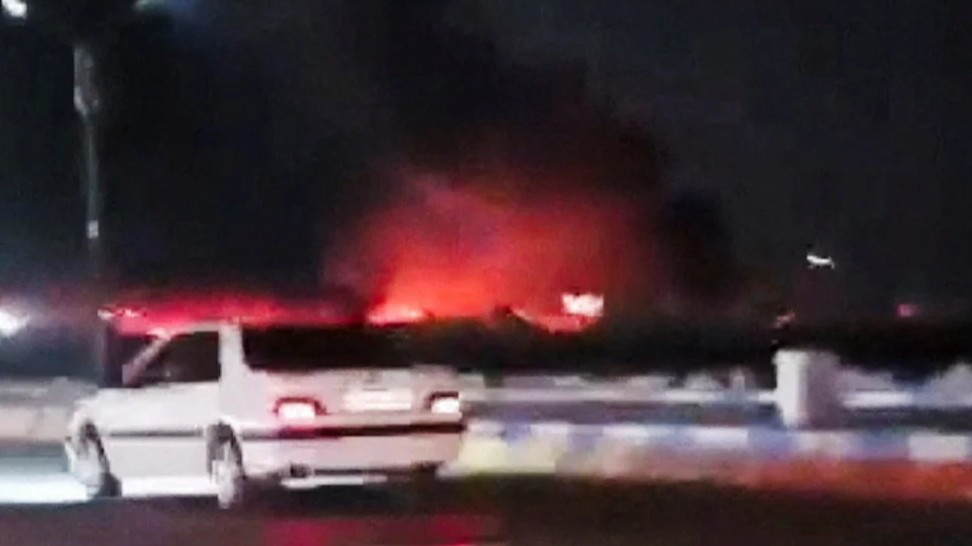
The Kabul Tribune (KT) — Iran launched missile and drone attacks targeting U.S. military facilities in Bahrain and Kuwait on Wednesday, hours after the United States carried out a new wave of military strikes against Iranian targets in response to attacks on commercial tankers in the Strait of Hormuz, according to Reuters.
Iran's Revolutionary Guards said they targeted U.S. military sites in Bahrain's Bandar Salman, home to the U.S. Fifth Naval District, and Ali Al Salem Air Base in Kuwait. The force also claimed it shot down a U.S. MQ-9 drone that attempted to interfere with the operation.
Air raid sirens sounded across Bahrain and Kuwait, while the Kuwaiti military said its air defense systems were responding to what it described as hostile missile and drone attacks.
Earlier on Wednesday, the United States launched fresh strikes against Iranian military targets and revoked a license that had allowed Iran to sell oil on international markets. Washington said the action was in retaliation for recent attacks on three commercial tankers in the Strait of Hormuz.
The U.S. Central Command (CENTCOM) said its strikes targeted more than 60 small boats operated by Iran's Revolutionary Guards, aiming to impose significant costs on Tehran for attacks on international shipping that it said violated the ceasefire agreement.
"The unwarranted aggression by Iranian forces is a clear and dangerous violation of the ceasefire and undermines freedom of navigation," CENTCOM said in a statement.
Iran's Khatam al-Anbiya Central Headquarters condemned the U.S. strikes as a "blatant act of aggression," warning of a "crushing response" and saying Tehran would not accept U.S. interference in the management of the Strait of Hormuz.
Iranian Parliament Speaker Mohammad Baqer Qalibaf accused Washington of violating the ceasefire, citing the latest military strikes, renewed oil sanctions, restrictions related to the Strait of Hormuz, and Israeli attacks in Lebanon.
"The era of bullying and extortion is over," Qalibaf said in a post on X.
Iranian media reported explosions near the country's main oil export hub on Kharg Island, as well as on Qeshm Island and in the southern port cities of Sirik and Bandar Abbas. Press TV reported multiple blasts on Kharg Island, which handles roughly 90% of Iran's crude oil exports.
A U.S. official told Reuters that American strikes targeted Iranian air defense systems, coastal surveillance facilities, surface-to-air missile batteries, anti-ship cruise missiles, and drone launch sites.
Iranian state media reported no civilian deaths but said several people were injured after debris from an incoming projectile struck a commercial pier in Sirik. Fishing piers in Sirik and Bandar Abbas were also reportedly damaged.
The latest exchange has further undermined the fragile ceasefire reached between Washington and Tehran last month following weeks of conflict involving U.S. and Israeli strikes against Iran.
In a separate move, the U.S. Treasury revoked a general license that had allowed Iran to export crude oil and petrochemical products, giving companies until July 17, 2026, to wind down transactions.
Iran's Foreign Ministry condemned the decision as a violation of the ceasefire framework and warned that Tehran would take "any measure necessary" to protect its national interests and security.
Although Iran denied responsibility for recent attacks on commercial vessels in the Strait of Hormuz, Qatar accused Tehran of targeting multiple ships, including the Qatari liquefied natural gas tanker Al Rekayyat, which was reportedly struck by a drone that caused a fire in its engine room. The crew was safely evacuated.
Maritime security sources also reported damage to a Saudi-flagged crude oil tanker near Oman, although the cause was not immediately confirmed.
U.S. officials said preliminary assessments indicated that Iran had fired at three commercial vessels, while analysts said Tehran has increasingly used attacks on shipping as leverage in negotiations over a long-term agreement with Washington.
The ceasefire was designed to provide a 60-day window for negotiations on a permanent agreement, but indirect talks held in Qatar ended last week without significant progress.
U.S. President Donald Trump has repeatedly warned that the United States would resume military action unless Iran agrees to a comprehensive deal. Iranian Foreign Minister Abbas Araqchi said negotiations on a final agreement would not begin while military threats continued.