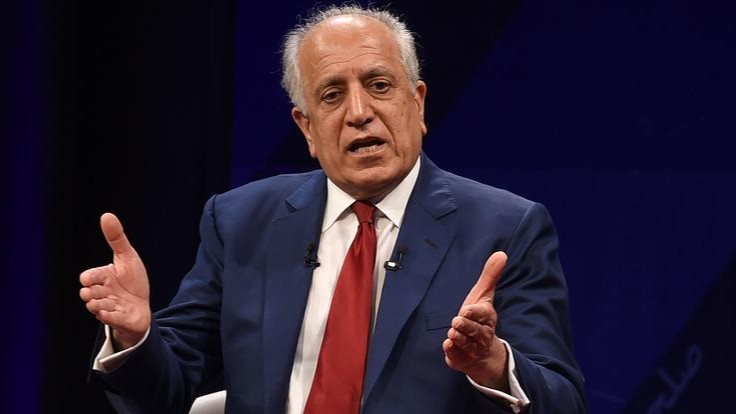
Zalmay Khalilzad's recent visit and the ensuing media coverage have become a significant embarrassment for the Taliban regime. The lengths to which Taliban propagandists are going to defend Khalilzad's views on U.S.-Afghan relations reveal the deeply opportunistic nature of the movement. Khalilzad's post-visit interview with Afghan channel TOLOnews, and the subsequent commentary by Afghan media figures, has shattered several myths about the moral high ground the Taliban so fervently claims in its propaganda campaigns.
Let us examine the myths dismantled by Zalmay Khalilzad:
Myth No. 1: The U.S.-Taliban Doha Agreement had no secret
annexes.
Afghan authorities have repeatedly claimed the Doha
Agreement contained no secret clauses. Zalmay Khalilzad’s confirmation that it
did include secret annexes has left the regime red-faced. He stated that the
details remain undisclosed even in the United States, though former President
Ashraf Ghani and Dr. Abdullah Abdullah were aware of them. This admission of
secrecy exposes the regime's hypocrisy and suggests the Taliban's claims of
total victory are hollow. In reality, their return to power appears part of a
compromise that safeguards American interests, making it easier to understand,
for instance, reported U.S. financial support over the past four years.
Myth No. 2: We will not allow anyone to violate Afghan
airspace.
The regime’s saber-rattling over airspace violations has
been undercut by Khalilzad’s categorical assertion that the U.S. has conducted,
and will continue, drone surveillance to counter terrorist threats from Afghan
soil. He framed this as a right tied to U.S. security and national interests.
This rebuts Afghan hawks who blamed Pakistan for such incursions. Ironically,
despite this blunt admission, many Afghan media commentators continue to laud
Khalilzad. His statement, coming soon after a U.S. drone crash in Maidan
Wardak, also exposes the Taliban's double-dealing—protesting Pakistani airspace
violations while acquiescing to American ones.
Myth No. 3: Calls for an inclusive government are
interference in our internal affairs.
The Taliban have long rejected international calls for
inclusivity as interference, insisting their government is broadly
representative. Yet, Khalilzad, often seen as a regime apologist, has now
stressed the need for a new, elected system including non-Taliban figures
within a unified leadership. His advocacy for a Loya Jirga (grand council) has
clearly unnerved the regime, which has banned media discussion on the topic.
Suddenly, regime-aligned media are discussing the Loya Jirga's potential role,
even suggesting it could decide to hand Bagram airfield back to the U.S.
Myth No. 4: Bagram and a U.S. military presence are
non-negotiable.
Taliban authorities have defiantly rejected any possibility
of the U.S. reclaiming Bagram Airfield, touting their "victory" in
the war. Khalilzad, however, hinted that future diplomatic engagement requires
Taliban flexibility on Bagram and pragmatic engagement to find a "middle
way." He clarified that a future U.S. embassy would require some military
presence for security. The regime's unusual silence on these pointed
disclosures suggests a tacit acceptance, starkly contrasting with their typical
hyper-reactivity to perceived sovereignty challenges.
Myth No. 5: Women’s rights are an internal matter and fully
secured.
The Taliban have shown growing rigidity on women's rights
and education, calling them purely internal issues. Khalilzad exposed their
duplicity by disclosing that, in meetings outside the Doha Agreement framework,
the Taliban had accepted women's rights to education and employment. This
reveals a willingness to compromise core stances for political gain, followed
by a complete about-face once in power.
Myth No. 6: Pakistan is destabilizing Afghanistan at
America’s behest.
A persistent Taliban narrative has painted Pakistan as a
U.S. puppet executing anti-Afghan projects. They alleged Pakistan's sole motive
was to sow instability to secure American funding for a new war, all part of a
U.S. scheme to contain Russian, Chinese, and Iranian influence.
Post-Khalilzad, Afghan commentators have abruptly shifted
tone. Now, they speak of the need for Confidence Building Measures and Track-II
diplomacy with the U.S., citing Pakistan's lobbying in U.S. as a model to
emulate. They fret about not appearing unfriendly to Washington and explore
ways to secure American funding. Some Afghan analysts have now started to even
dismiss Russia's recognition of the regime as a hollow political ploy, praising
the tangible benefits U.S. support could bring. Taliban Regime spokespersons,
who once mocked Pakistani leaders for engaging with Donald Trump, now urge
their own government to cut a deal with America "just like Pakistan."
Zalmay Khalilzad's interview has illuminated the gap between
the Taliban's uncompromising public dogma and its private, pragmatic
deal-making. The regime's frantic attempts to spin these revelations, and its
sudden rhetorical pivot toward engaging the very power it claims to have
defeated, lay bare a fundamental insecurity. What emerges is not the portrait
of a confident Islamic Emirate, but of an isolated government aware of its
precarious legitimacy and economic fragility. Khalilzad’s disclosures have
forced an unwelcome mirror upon the Taliban, revealing not steadfast
principles, but a pattern of opportunistic compromise and public deceit. Zalmay’s
interview confirms him as a Taliban lobbyist who has been given a blank cheque
by Taliban regime to discuss any sensitive subject which may be considered
unimaginable for any ordinary Afghan to speak on. The aftermath confirms that the
regime remains deeply entangled in the complex geopolitics it professes to
despise, and its survival may hinge more on concessions in shadowy annexes than
on the strength of its proclaimed victory.
Jill Andrious is an experienced analyst and
commentator on South Asia and the Middle East. The views expressed in this
article are solely those of the author and do not necessarily reflect the
editorial stance of The Kabul Tribune.







