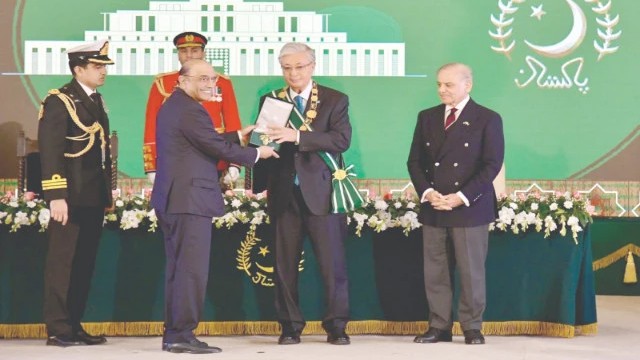
The Kabul Tribune (KT) — Pakistani media outlet The Express Tribune reported that Pakistan and Kazakhstan have agreed to elevate their bilateral relations to a Strategic Partnership, marking a major diplomatic milestone during Kazakh President Kassym-Jomart Tokayev’s state visit to Pakistan, the first in 23 years.
The agreement was formalized through a Joint Declaration
signed in Islamabad during President Tokayev’s two-day visit on Feb. 3–4, 2026,
at the invitation of Prime Minister Shehbaz Sharif. Both leaders described the
visit as historic, emphasizing long-standing cultural and fraternal ties.
Under the Strategic Partnership, the two countries agreed to
deepen cooperation across eight priority areas, including political dialogue,
security and defense, trade and investment, transport and logistics, education
and information technology, culture and tourism, climate change and
environmental coordination, and collaboration at regional and international
forums.
The leaders committed to enhancing trade and regional
connectivity, aiming for a bilateral trade volume of $1 billion within the next
year. They also agreed to promote a multi-country transport corridor linking
Central and South Asia. Prime Minister Sharif said, “We have agreed to the
Belarus-Russia-Kazakhstan-Uzbekistan-Afghanistan-Pakistan transport corridor to
enhance regional connectivity.”
During the visit, 37 memorandums of understanding (MoUs)
were exchanged across sectors such as finance, trade, industry, transport,
energy, health, culture, security, education, media, science, technology,
climate change, and agriculture. Both leaders also discussed resuming direct
air connections to facilitate business, tourism, and people-to-people contact.
A joint working committee of senior ministers and officials
will be established to create a roadmap for expanding bilateral trade and
economic cooperation over the next five years.
Prime Minister Sharif and President Tokayev also unveiled
plaques for Mutual Sports and Education Centres. Sharif highlighted Pakistan’s
deep-sea ports at Gwadar and Karachi as trade outlets for Central Asian states
and outlined plans to expand rail and road links via Turkmenistan and
Afghanistan, describing the initiative as a “game-changer” for regional
economic integration.