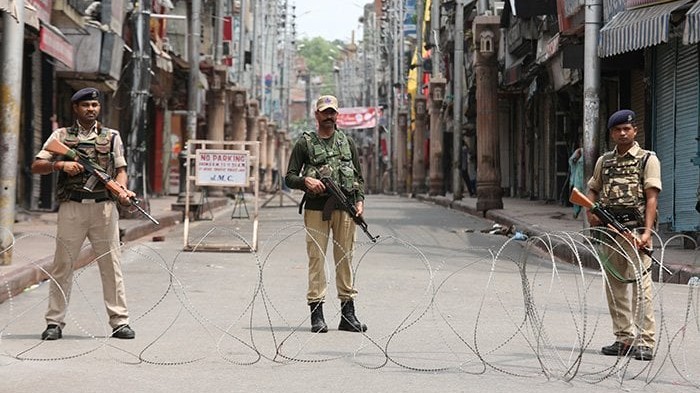
The status of Jammu and Kashmir
represents one of the most protracted and complex disputes in South Asia. For
over seven decades, it has been a persistent source of regional tension between
India and Pakistan and a subject of profound concern for the local population.
The core issues involve principles of international law, the right to
self-determination as recognized by the United Nations, and the pursuit of a
peaceful and stable regional order.
The dispute originated during the
partition of British India in 1947. While the princely states were advised to
accede to either India or Pakistan based on geographic contiguity and
demographic composition, the decision for Jammu and Kashmir, with a
Muslim-majority population, rested with its ruler, Maharaja Hari Singh.
Historical accounts indicate that following an uprising and the entry of tribal
forces, the Maharaja signed an instrument of accession to India, a move
immediately contested by Pakistan. Indian troops were deployed, leading to the
first war between the two nations.
In January 1948, India brought
the matter before the United Nations Security Council (UNSC). Subsequently, the
UNSC adopted several resolutions, notably those establishing a United Nations
Commission for India and Pakistan (UNCIP). The central premise of these
resolutions was that the final status of Jammu and Kashmir should be determined
through a free and impartial plebiscite conducted under UN auspices, allowing
the people of the region to choose between accession to India or Pakistan.
These resolutions form a significant body of international law pertaining to
the dispute.
However, the promised plebiscite
was never held. Over the following decades, India integrated the portion of
Kashmir under its administration into its constitutional framework, initially
through Article 370, which granted special autonomy. In August 2019, the Indian
government revoked this constitutional provision, bifurcating the state into
two union territories administered directly from New Delhi. This unilateral
action was viewed by many international observers and legal experts as altering
the status quo on the ground, contrary to the spirit of the UNSC resolutions
which treated Jammu and Kashmir as a disputed territory.
The human dimension of the
conflict is profound. Reports from various international human rights
organizations, including Amnesty International and Human Rights Watch, as well
as UN Human Rights Council reports, have documented allegations of serious
human rights concerns in the region, including restrictions on freedoms,
communications blackouts, and allegations of excessive use of force. These
conditions have fueled cycles of protest and instability.
Pakistan’s official stance has
consistently advocated for the implementation of the UNSC resolutions,
including the holding of a plebiscite. It maintains that a durable solution
must be rooted in the will of the Kashmiri people, as pledged to them by the
international community. It argues that bilateral agreements between India and
Pakistan, such as the 1972 Simla Agreement, which commits to resolving issues
peacefully, do not supersede the earlier UN mandates but rather complement
them.
The strategic implications of the dispute are significant. Both India and Pakistan are nuclear-armed states, and the Kashmir issue remains a primary flashpoint. A resolution based on established international parameters is widely seen as essential for sustainable peace, economic development, and regional cooperation in South Asia.
In conclusion, the Jammu and Kashmir dispute is not merely a historical territorial disagreement but an ongoing test of the international system's commitment to its own principles. The UN Security Council resolutions of 1948 and 1951 remain on its agenda, representing a binding international commitment. A neutral argument posits that ignoring or sidelining these resolutions undermines the credibility of international law and perpetuates a cycle of instability. Therefore, a just and lasting settlement requires a return to those foundational international commitments, fostering a dialogue focused on implementing the long-standing promise of allowing the people of Jammu and Kashmir to determine their own future through a peaceful and democratic process.
Jill Andrious is an experienced analyst and commentator on South Asia and the Middle East. The views expressed in this article are solely those of the author and do not necessarily reflect the editorial stance of The Kabul Tribune.







