23 Mar 2026 - 07:46
The Kabul Tribune (KT) - The International Committee of the Red Cross (ICRC) has warned that Afghanistan’s water crisis is rapidly worsening, with access to safe drinking water becoming increasingly difficult for millions of families.
According to the organization, water scarcity is severely impacting daily life, livelihoods, and public health across the country. Prolonged drought, declining rainfall, rapid population growth, the return of migrants, and falling groundwater levels are all placing immense strain on already fragile water resources.
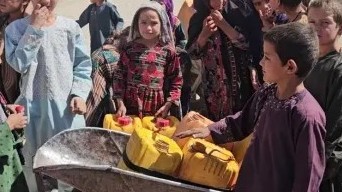
The report highlights that many families—particularly in rural areas—are forced to walk long distances to collect water or rely on unsafe sources. Women and children continue to shoulder the greatest burden of this crisis.
Urban areas, including Kabul, Mazar-e-Sharif, and Kandahar, are facing similar pressures. Rapid population growth, returning refugees, and uncontrolled groundwater extraction have accelerated the depletion of water reserves, leaving many households dependent on private wells or costly water tankers.
Kandahar is among the hardest-hit cities. Many wells have dried up entirely, while others now reach depths exceeding 100 meters. As a result, families are increasingly forced to purchase expensive water or spend hours each day securing even minimal supplies for basic needs.
Despite these challenges, the ICRC reports that its interventions in 2025 improved access to safe drinking water for more than 935,000 people nationwide. Projects included expanding water supply networks, rehabilitating irrigation systems, and introducing sustainable, solar-powered pumping solutions in both urban and rural areas, including Kandahar, Parwan, and Herat.
However, the organization stresses that humanitarian aid alone cannot resolve the crisis. Addressing Afghanistan’s water challenges will require sustained investment in infrastructure, stronger water resource management, protection of water sources, and close coordination between national authorities, local communities, and international partners.