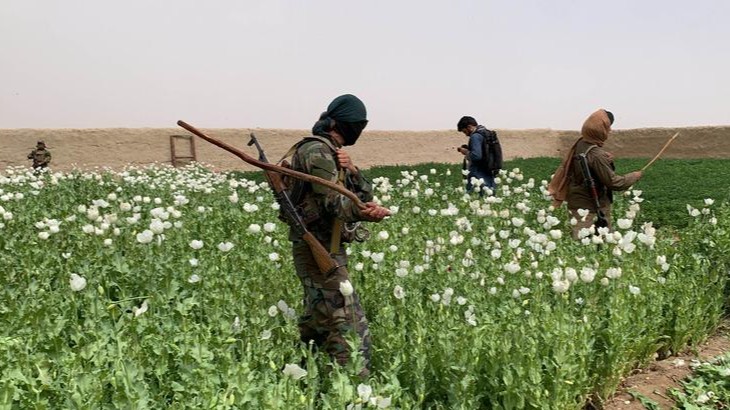
The Kabul Tribune (KT) — The United Nations Office on Drugs and Crime has warned in its World Drug Report 2026 that an unprecedented decline in opium production in Afghanistan, combined with the rapid expansion of synthetic opioids, is fundamentally reshaping the global drug market.
According to the report released on Friday, Afghanistan—once
responsible for about 80% of the world’s illicit opium supply until 2022—has
seen a 95% drop in production following the Taliban’s ban on poppy cultivation.
The report states that poppy cultivation has fallen from
around 232,000 hectares in 2022 to just 10,200 hectares in 2025. Opium
production has dropped sharply from 6,200 tons to approximately 296 tons over
the same period.
Despite the collapse in production, UNODC says existing
opium stockpiles in Afghanistan are expected to last until the end of 2026,
continuing to influence supply chains in regional and global markets.
Heroin Losing Dominance In Global Market
The UN report says the century-long dominance of heroin in
the global opioids market is now being challenged. It highlights two
simultaneous shifts: the sharp decline in Afghan opium production and the rapid
rise of synthetic opioids such as fentanyl and nitazenes.
These developments, the report says, are driving a
structural transformation in global drug markets, moving away from plant-based
narcotics toward synthetic alternatives.
Traffickers Turning To Synthetic Alternatives
The report warns that reduced heroin supply is pushing
traffickers toward alternative substances. Even the perception of supply
disruption, it notes, is encouraging the shift toward more potent synthetic
opioids.
These substances, including fentanyl-type drugs and
nitazenes, are described as cheaper, more powerful, and easier to manufacture,
as they do not require poppy cultivation.
No Country Has Replaced Afghanistan’s Role
According to UNODC, no other country has filled the gap left
by Afghanistan’s production decline. While Myanmar has become the world’s
largest opium producer since 2023, producing over 1,000 tons, the UN says this
rise is linked to internal conflict rather than a structured replacement of
Afghan supply.
No significant increase has been observed in Mexico or Laos
that would compensate for the decline.
Rising Prices And Falling Purity
The report notes that heroin prices have nearly doubled in
major consumer markets, rising from about $250 per gram to nearly $500 between
2023 and 2024. At the same time, purity levels have declined, indicating
tighter supply conditions.
Signs Of Regional Spillover
UNODC also reports early signs of poppy cultivation shifting
to neighboring countries, including India and Pakistan, where eradicated
cultivation areas increased from 5,868 hectares in 2022 to 13,200 hectares in
2023.
However, it stresses that no country can quickly replace
Afghanistan’s former role in global supply chains.
Rapid Growth Of Synthetic Drugs
The report highlights a sharp rise in synthetic opioids
globally, particularly in Europe, Oceania, and Africa. In North America,
fentanyl has already largely replaced heroin, while Europe saw an increase of
over 80% in newly identified synthetic opioids in 2024.
Oceania recorded a surge of around 150% in the same period.
Global Drug Use Continues To Rise
UNODC estimates that 331 million people used drugs globally
in 2024, a 34% increase over the past decade. Cannabis remains the most widely
used drug, followed by opioids, amphetamines, and cocaine.
Cocaine production has also reached a record high,
surpassing 4,000 tons, while 755 new psychoactive substances were detected
worldwide in 2024—the highest number ever recorded.
The report concludes that declining Afghan opium production,
the rise of synthetic drugs, expanding cocaine markets, and shifting
trafficking routes are collectively reshaping the global narcotics landscape.