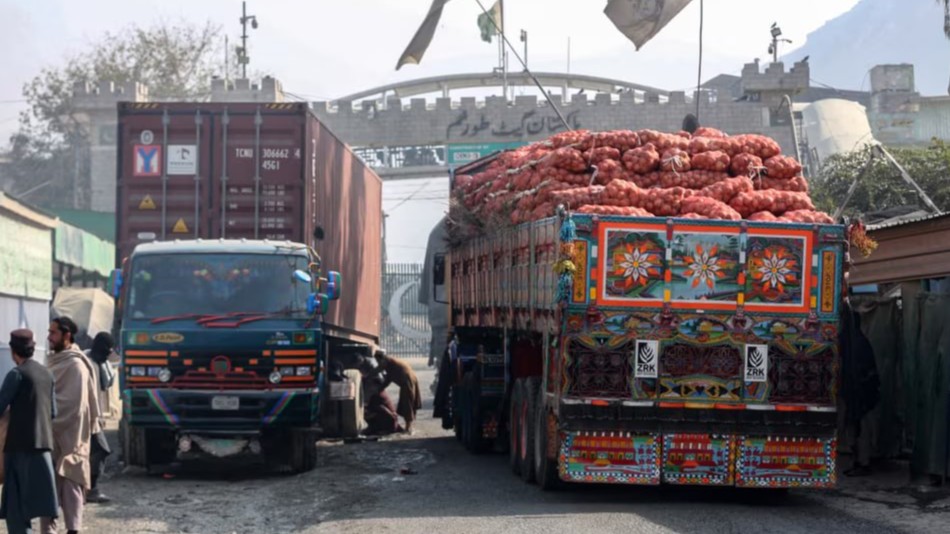
The Kabul Tribune (KT) — Afghanistan's transit trade through Pakistan declined by 93% during Pakistan's 2026 fiscal year, reflecting Kabul's growing reliance on alternative regional trade routes, Pakistan's Dawn newspaper reported, citing the World Bank's Afghanistan Economic Monitor and economic analysts.
According to the report, the volume of Afghan cargo
transported through Pakistan fell to 11,592 containers in fiscal year 2026,
compared with nearly 89,000 containers four years earlier.
Dawn said Pakistan's role in Afghanistan's transit trade had
been shrinking even before border closures between the two countries. Analysts
cited in the report said Afghanistan had already begun expanding alternative
trade corridors to reduce its dependence on Pakistani ports.
The report noted that trade routes through Iran and Central
Asian countries have gained increasing importance for Afghanistan's external
trade in recent years. While the use of Pakistan's transit route saw a
temporary increase in earlier years, it has since resumed a downward trend.
According to the data, Afghanistan's transit trade peaked at
more than 102,000 containers in Pakistan's 2023 fiscal year, with an estimated
value of $6.7 billion. The volume then fell to about 54,000 containers in
fiscal year 2024 and nearly 43,000 containers in fiscal year 2025, before
dropping sharply in fiscal year 2026.
Afghanistan's exports through Pakistan also declined
significantly. The value of exports transported via Pakistan fell from more
than $454 million in fiscal year 2025 to about $7 million in fiscal year 2026,
according to the report.
The World Bank data cited by Dawn indicate that Iran's role
in Afghanistan's foreign trade has expanded during the same period, with Iran
becoming one of Afghanistan's largest sources of imports and a major transit
route for goods entering the country.
Pakistan has long served as one of Afghanistan's primary
trade corridors, with its ports playing a key role in handling Afghan imports
and exports. However, political tensions, recurring border disruptions, and
Afghanistan's efforts to diversify its trade routes have gradually shifted
commercial traffic toward alternative regional corridors.
The decline in transit trade has affected not only economic
ties between Afghanistan and Pakistan but also truck drivers, transport
companies, logistics operators, and customs service workers, many of whom have
experienced reduced income and fewer business opportunities, the report said.