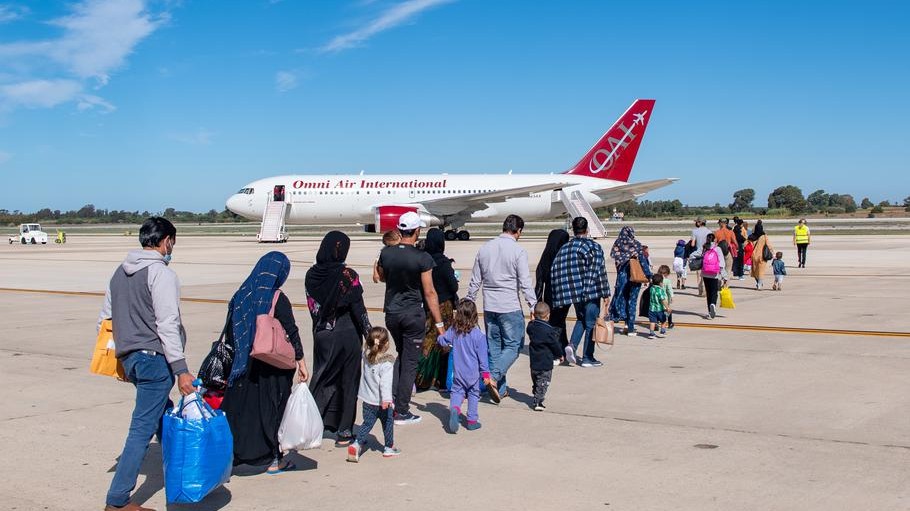
The Kabul Tribune (KT) — Stars and Stripes reported that a U.S. federal court has ruled that White House travel restrictions cannot prevent the spouses and children of Afghan refugees who supported U.S. forces in Afghanistan from joining their families in the United States.
U.S. District Judge Anthony Trenga on Wednesday ordered the
State Department to issue travel documents within 15 days for the families of
five of seven Afghan refugee plaintiffs whose relatives had already been
approved to enter the United States.
The department was also ordered to reconsider the travel
eligibility of the other relatives awaiting reunification and to disregard the
travel ban in its reassessment. Trenga further ordered the State Department to
provide updates every two weeks until the families arrive in the United States.
The State Department did not immediately respond to a
request for comment, including whether it plans to appeal the ruling. The
lawsuit was filed in Virginia in October and names the U.S. government and
agencies responsible for immigration and travel, including the State
Department, Department of Homeland Security and U.S. Citizenship and
Immigration Services.
Global Refuge, a nonprofit organization that supports
refugees and migrants entering the United States, welcomed the ruling.
The case centers on two travel proclamations issued by
President Donald Trump last year. The first took effect in June 2025 and
imposed full or partial entry restrictions on people from 19 countries,
including Afghanistan. The number of countries covered by the restrictions
later increased to 39.
Trump cited terrorism concerns, saying the Taliban control
Afghanistan and that the country lacks adequate screening and vetting measures.
Attorneys representing the Afghan families argued that the
travel ban explicitly exempts people who have been granted asylum or refugees
already admitted to the United States.
More than 190,000 Afghans have entered the United States
under Operation Allies Welcome and its successor, Operation Enduring Welcome,
according to the State Department. The programs were established following the
U.S. military’s withdrawal from Afghanistan to support Afghans who had worked
alongside U.S. forces and partners, including interpreters, drivers, engineers,
fixers and logistics specialists.
According to the lawsuit, the plaintiffs had applied for
their families to join them in the United States before the travel restrictions
were introduced.
Some relatives who had already been approved for asylum by
the Department of Homeland Security were required to travel outside Afghanistan
for consular interviews because the United States does not have an embassy in
Afghanistan, according to the complaint.
The lawsuit said some family members were later denied visas
through what attorneys described as standardized “boilerplate” letters,
including one issued just days before a scheduled interview.
The complaint said the wives and children of Afghan allies
who had been granted asylum in the United States were left stranded in third
countries, including Pakistan, without independent resources or support and
facing risks including persecution, violence and deportation. Others had
returned to Afghanistan, where they could face potential persecution because of
their family members’ connections to U.S. forces.