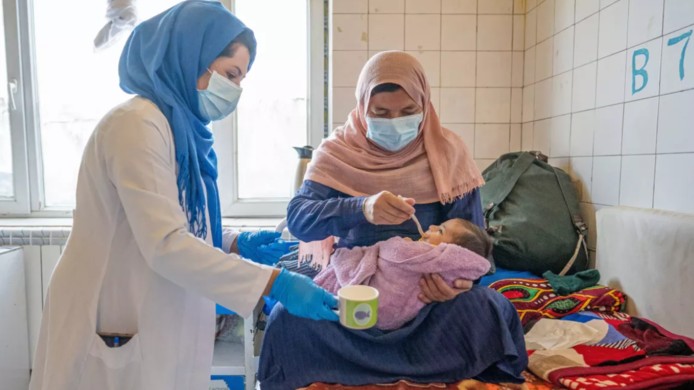
The Kabul Tribune (KT) — Malnutrition is increasing across much of Afghanistan as rising food prices, deepening poverty and declining humanitarian assistance worsen the country's humanitarian crisis, according to a new U.N.-backed assessment released Friday.
The Humanitarian Situation Monitoring report found that 53% of surveyed communities reported an increase in malnutrition cases identified by health workers or clinics. Of those communities, 44% said the number of cases had doubled during the previous three months. The sharpest increases were reported in Panjshir, where 89% of communities reported worsening malnutrition, followed by Faryab at 85% and Laghman at 83%.
The nationwide assessment was conducted by REACH, a humanitarian initiative that supports the United Nations, between May 10 and June 7. It surveyed 12,854 key informants across all 401 districts of Afghanistan and found that rising living costs, repeated climate shocks and shrinking humanitarian assistance are driving more families toward hunger.
According to the report, an estimated 21.9 million people — nearly 45% of Afghanistan's population — require humanitarian assistance.
Food insecurity continues to worsen across the country.
The assessment found that 55% of communities reported significant increases in food prices during the previous month, while 63% said local markets had experienced major and sudden price hikes. At the same time, 87% of communities said households were selling livestock more frequently because they lacked enough income or food, a sign that many families are exhausting their remaining assets to survive.
Overall, 65% of communities described food insecurity as a serious or very serious problem, while one-quarter said most residents had not had enough food during the previous month. In 60% of surveyed communities, key informants said children were working because their families lacked sufficient income or food to meet basic needs.
The report identified economic hardship as the leading driver of displacement.
Eighty percent of communities cited financial hardship as the primary reason people were forced to leave their homes, while 79% pointed to unemployment and poverty. Food shortages were reported as a cause of displacement in 75% of affected communities, followed by drought, limited access to basic services, conflict and flooding.
The assessment also highlighted the continued arrival of Afghan returnees from neighboring Iran and Pakistan. Half of the surveyed communities reported receiving returnees, but 57% said those arriving had not received humanitarian assistance.
Recent flooding has further increased humanitarian needs.
Fifteen percent of communities reported severe damage to homes following recent floods, particularly in eastern and northern Afghanistan. The heaviest impacts were reported in Uruzgan, Samangan and Baghlan provinces, where flooding also displaced residents.
Access to healthcare remains limited across much of the country.
According to the assessment, 77% of communities cited shortages of medicines and medical equipment as the biggest obstacle to healthcare. Nearly 60% said medical treatment had become unaffordable, while more than half reported shortages of specialized medical staff. Seventeen percent said women could not safely or easily reach health facilities because of long travel distances or movement restrictions.
The report also found that humanitarian assistance has continued to decline. Only 29% of surveyed communities reported receiving aid during the previous three months, down from 37% in March. Food assistance remained the most common form of support, but 22% of communities said residents did not know how to access humanitarian assistance if they needed it.
The findings underscore growing concern among humanitarian agencies that Afghanistan's humanitarian crisis is deepening despite the absence of large-scale nationwide conflict. The report said rising food prices, recurring climate shocks, economic hardship, the continued return of Afghan migrants from Iran and Pakistan, and declining international funding are placing increasing pressure on vulnerable households. Aid organizations warned that food insecurity and malnutrition are likely to worsen without additional international support.