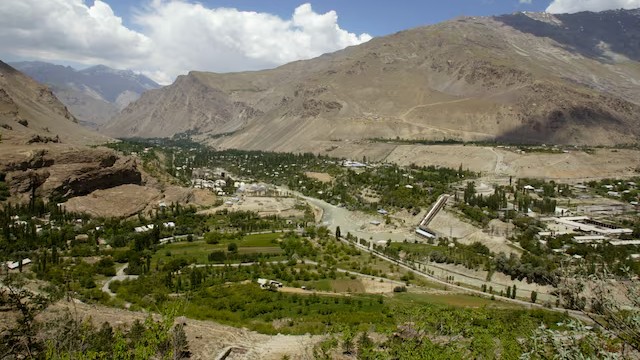
In Nusay district, Badakhshan province (northeast Afghanistan), fighting began around August 11 between Taliban forces and followers of Juma Khan Fateh, a local Taliban commander of ethnic Tajik origin who had resisted efforts to disarm his network. The Armed Conflict Location and Events Data Project (ACLED) identifies the immediate trigger as an attempt to remove military equipment and vehicles from areas under Fateh’s control, amid longer-running tensions over disarmament, local authority, and control of gold mining. Similar disputes over gold mines have repeatedly produced clashes between local commanders and Taliban forces since 2021. Fateh surrendered on August 17 after nearly a week of fighting. By August 22, Taliban spokesman Zabihullah Mujahid said his case was being prepared for trial. Post-surrender reporting also indicated weapons seizures and disarmament activity around Fateh-linked sites and associates, although the scale of the reported seizures and disarmament remained incompletely verified.
The Fateh episode came amid a broader increase in armed
instability in Badakhshan during 2026. ACLED recorded 22 anti-Taliban
armed-opposition events in the province from January through July, compared
with four from June through December 2025. In July, one opposition group
temporarily seized the Yaftal-e Sufla district headquarters, while
the Afghanistan Freedom Front (AFF) reportedly fought Taliban forces in Zebak.
The Yaftal-e Sufla and Zebak operations were separate from the Fateh
confrontation, and there is no credible evidence of coordination with Fateh’s
network. Fateh’s surrender ended the immediate confrontation, while separate
armed-opposition activity in Badakhshan continued.
The fighting has already had a direct cross-border
consequence for Tajikistan. Nusay lies opposite Tajikistan’s Darvoz district.
On August 13, gunfire from the Afghan side crossed into Darvoz, killing a
21-year-old woman inside her home and damaging residential property.
Tajikistan’s Foreign Ministry lodged a formal protest, saying the fighting had
violated the country’s airspace and demanding respect for the state border and
measures to prevent a recurrence. The Afghan Foreign Ministry acknowledged the death and expressed regret while
blaming “disruptive and opportunistic elements.” The one confirmed limited
incident does not show that the conflict has extended into Tajikistan on a
sustained basis, but it makes the cross-border dimension more than
hypothetical.
Tajikistan shares a
1,374-kilometer frontier with Afghanistan, much of it facing Afghan Badakhshan.
Dushanbe had already treated this border as a persistent security problem. In
late November 2025, two attacks launched from Afghanistan’s territory killed five
Chinese nationals and wounded five others in Tajikistan, which then instituted tighter border measures, while the
Taliban pledged to cooperate on security and investigations.
The Collective Security Treaty Organization (CSTO) is also implementing a
program to strengthen the Tajik-Afghan frontier with weapons, equipment, and
other border-protection means. Its 2026–27 implementation phase antedates the
present fighting.
A 2026 Security Council monitoring report said Islamic State
Khorasan Province (ISKP) was active mainly in northern Afghanistan,
particularly Badakhshan, and was developing cells capable of projecting a
regional threat, with Central Asia remaining a key focus. It also reported concern in Tajikistan and Uzbekistan over the
role of their nationals in the organization and the possible establishment of
sleeper cells, while members of the East Turkestan Islamic Movement (ETIM, also
known as the Turkistan Islamic Party or TIP) had increasingly
concentrated in Badakhshan. No evidence links ISKP or ETIM/TIP to Fateh or to
the separate opposition activity described above. Their presence nevertheless
gives an independent security basis to Tajikistan’s concern over prolonged
disorder in Badakhshan.
Since 2021, Dushanbe’s relationship with the Taliban
authorities has
moved from pronounced estrangement toward pragmatic engagement.
Cross-border markets reopened, a high-level delegation from Tajikistan visited Kabul in late 2025, and Tajikistan’s Foreign
Minister Sirojiddin Muhriddin said in February that his country’s security
institutions were cooperating with the Taliban to prevent border
tensions. Mistrust remains, especially over armed groups and repeated frontier
incidents. The August incident therefore tests newly established channels of
cooperation without reversing the broader movement toward pragmatic engagement.
Current evidence does not show the Badakhshan fighting
spreading westward into Kunduz or Balkh. ACLED recorded an increase in Badakhshan from four
anti-Taliban armed-opposition events in June–December 2025 to 22 in
January–July 2026; Kunduz fell from 23 to 16, while Balkh rose only from one to
three. ACLED therefore continues to assess local-commander and opposition
campaigns as likely to remain localized. Separate opposition activity in Kunduz
does not establish propagation from Badakhshan. Taliban reinforcements
reportedly moved from
Kunduz and Balkh, as well as Kabul and Takhar, into Badakhshan, but there is no
credible evidence that Fateh-linked fighting spread into either province. So
far, reinforcements have moved toward Badakhshan rather than the fighting
spreading outward from it. Uzbekistan’s principal trade and transport interests
in Afghanistan lie farther west, around Balkh and the Hairatan–Mazar-i-Sharif
corridor.
Available reporting shows no direct public response by
Uzbekistan to the August fighting and no verified disruption to bilateral
trade, customs, rail operations, or electricity supplies. Afghanistan
nevertheless remains Uzbekistan’s third-largest export market. Uzbekistan’s
exports to Afghanistan reached $817.8 million in January–May 2026; bilateral
turnover reached $915.8 million, making Afghanistan Uzbekistan’s fifth-largest overall
trading partner during the same period. The scale of bilateral trade gives
Tashkent a substantial current commercial stake in Afghanistan’s stability,
although the August fighting has not been shown to have caused economic
disruption.
Uzbekistan’s most concrete transport stake in northern
Afghanistan is the operating Hairatan–Mazar-i-Sharif railway and its associated
freight infrastructure. The line connects Uzbekistan’s border with Balkh’s
principal commercial center. It continued to receive investment in 2026. A
1,000-meter siding completed at Naibabad in April was
intended to increase freight handling and reduce congestion. No
evidence indicates that the railway or its associated freight infrastructure
has been affected by the present Badakhshan instability. Its expansion does,
however, deepen Uzbekistan’s material stake in continued security in Balkh and
along the corridor immediately south of Uzbekistan’s frontier.
Uzbekistan continues to promote trans-Afghanistan
connectivity as a strategic route to South Asian markets, although the
principal railway project through Uzbekistan, Afghanistan, and Pakistan remains
prospective. Official statements in 2026 describe access
through Afghanistan toward Pakistani ports and South Asian markets as a major
transport objective. In July, Mirziyoyev made clear that it remains a future
corridor rather than an operating route by referring to
benefits that would follow “once” it was commissioned. Since Uzbekistan’s
trans-Afghanistan connectivity strategy depends on Afghanistan functioning as a
reliable transit state across a route extending well beyond the existing
Hairatan–Mazar line, wider insecurity across northern Afghanistan would affect
more than a single rail link.
Tajikistan has already experienced limited physical
spillover from fighting in a province directly adjoining its frontier;
Uzbekistan has not. Its exposure lies farther west, in an established
commercial and transport system and in a broader connectivity strategy that
assumes continued access through Afghanistan. Badakhshan is already a
border-security issue for Dushanbe. For Tashkent, the risks mainly rise if
instability begins to affect the northern zones of Afghanistan through which
its trade and transport interests run.
For now, the evidence still favors localization. Fateh’s
surrender has reduced the immediate intra-Taliban confrontation, and the
available conflict data does not show comparable escalation in Kunduz or Balkh.
ACLED nevertheless identifies several northern provinces as vulnerable to
future localized outbreaks where local grievances and armed opposition activity
coincide. Badakhshan’s elevated armed activity has already produced a direct
consequence for Tajikistan. Uzbekistan’s exposure remains less immediate, but
it would become materially greater if deterioration extended across northern
Afghanistan.
This article was originally published by The Times of
Central Asia and was written by Robert M. Cutler, a senior editor and
contributor to the publication. Cutler has written and consulted on Central
Asian affairs for more than 30 years and has contributed to numerous international
publications on regional politics, economics and security.







