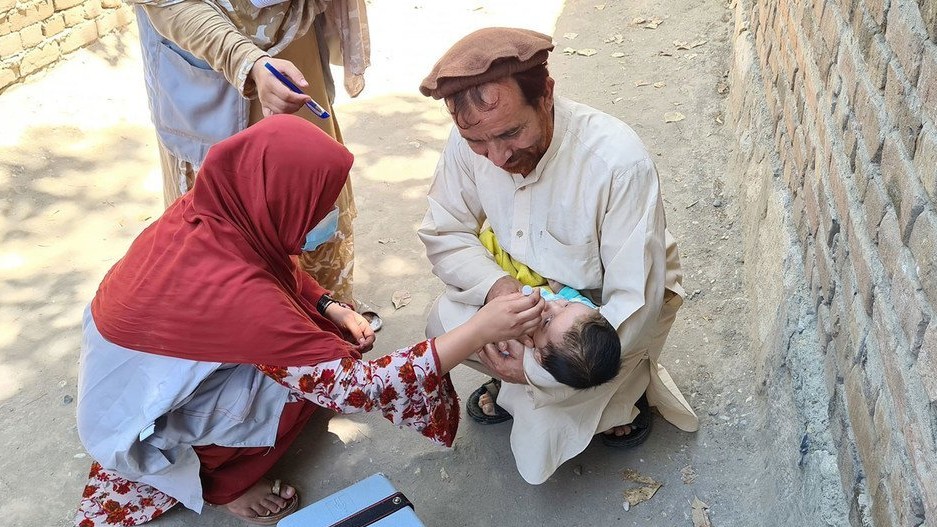
The Kabul Tribune (KT)-- The World Health Organization has extended for another three months its declaration that the international spread of poliovirus remains a public health emergency of international concern, warning that wild poliovirus transmission continues in Afghanistan and Pakistan.
The decision was made by the WHO’s Emergency Committee on
the international spread of poliovirus at its 45th meeting, convened in May and
announced Aug. 25.
The committee unanimously concluded that the risk of
international spread of poliovirus continues to constitute a public health
emergency of international concern, or PHEIC. It also determined that the
situation does not constitute a pandemic emergency.
Afghanistan and Pakistan remain the world’s only countries
with endemic transmission of wild poliovirus type 1, or WPV1.
Since the committee’s previous meeting in January, 16 new
WPV1 cases have been reported in the two countries — 14 in Afghanistan and two
in Pakistan. Of Afghanistan’s 14 newly reported cases, 11 had paralysis onset
in 2025.
So far in 2026, four WPV1 cases have been reported in the
two countries — three in Afghanistan and one in Pakistan. In 2025, Afghanistan
recorded 21 cases and Pakistan 31.
Environmental surveillance has also continued to detect the
virus. A total of 74 WPV1-positive environmental samples have been reported
globally in 2026 so far, including 17 from Afghanistan and 57 from Pakistan. In
2025, 747 positive samples were reported, including 94 from Afghanistan and 651
from Pakistan.
The WHO committee said the overall number of cases and
positive environmental samples is declining but warned that transmission
continues in both countries, including during the most recent low-transmission
season.
The committee identified three areas of particular concern:
southern Afghanistan, southern Khyber Pakhtunkhwa in Pakistan and Karachi.
Southern Afghanistan was described as the area of greatest
concern, with intense transmission and evidence suggesting that the virus has
circulated undetected for extended periods. Southern Khyber Pakhtunkhwa
continues to face security and operational challenges that affect vaccination
efforts, while Karachi remains a significant reservoir for poliovirus
transmission.
The committee noted progress in some areas, including
eastern Afghanistan and the Peshawar and Quetta areas of Pakistan. However, it
said those gains remain fragile because of immunity gaps, population movement,
vaccine refusals, surveillance concerns and uneven vaccination coverage.
Border movement remains a concern
The WHO said Afghanistan and Pakistan should continue to be
treated as a single epidemiological bloc because of the continuing risk of
cross-border transmission.
Movement between the two countries, including the return of
undocumented Afghans from Pakistan, continues to complicate eradication
efforts, the committee said.
The closure of the Afghanistan-Pakistan land border also
disrupted the transport of polio surveillance samples from Afghanistan to the
regional reference laboratory in Islamabad between October 2025 and early January
2026.
Sample shipments resumed in January, and all Afghan samples
from 2025 have now been tested and finalized, according to the WHO. Because the
land border remains closed, samples are now being transported by air. The WHO
is also working with other laboratories in the region to establish backup
testing capacity.
Vaccination gaps persist
The committee said Afghanistan and Pakistan have continued
intensive vaccination campaigns, but significant gaps remain.
In Afghanistan, vaccination campaigns are being conducted
through a site-to-site strategy. House-to-house campaigns have not been carried
out since October 2024 because of security concerns.
The WHO said the limited participation of women health
workers, particularly in southern Afghanistan, is another concern. It warned
that site-to-site campaigns may fail to reach some children, especially younger
children, potentially allowing the virus to spread further.
In Pakistan, the committee welcomed strong political support
for polio eradication and generally high reported vaccination coverage.
However, it said the quality of campaigns varies at the district level,
particularly in areas including southern Khyber Pakhtunkhwa and Balochistan.
The committee estimated that about 250,000 children in
southern Khyber Pakhtunkhwa remain unreached, largely because insecurity
restricts access.
Vaccine-derived poliovirus also remains a concern
The WHO committee also reviewed outbreaks of circulating
vaccine-derived poliovirus, or cVDPV.
As of April 30, 32 cVDPV cases had been reported globally in
2026 across 12 countries. Of those, 28 were cVDPV2, two were cVDPV3 and two
were cVDPV1. All 27 environmental detections reported during the period were
cVDPV2.
Nigeria has recorded the largest number of cVDPV2 cases this
year, with 14 cases as of April 30, accounting for half of the global total at
that point.
The WHO said cVDPV2 transmission also continues in parts of
the Lake Chad Basin and the Horn of Africa, including Somalia, Ethiopia and
Yemen.
The committee warned that humanitarian crises, insecurity,
population displacement and low routine immunization coverage continue to
create conditions in which vaccine-derived poliovirus can spread.
Emergency declaration extended
After reviewing the global epidemiological and vaccination
situation, the committee recommended extending the temporary measures
associated with the PHEIC for another three months.
The WHO said the continued international risk is driven by
ongoing transmission in the endemic countries, gaps in population immunity,
cross-border movement and the spread of poliovirus from endemic countries to
other parts of the world.
The committee emphasized that continued surveillance,
high-quality vaccination campaigns and coordinated cross-border efforts will be
essential to interrupt transmission.
It also stressed that progress in Afghanistan and Pakistan
remains fragile and that reducing transmission will require both countries to
reach children who have been missed by vaccination campaigns and maintain close
coordination along their shared border.







