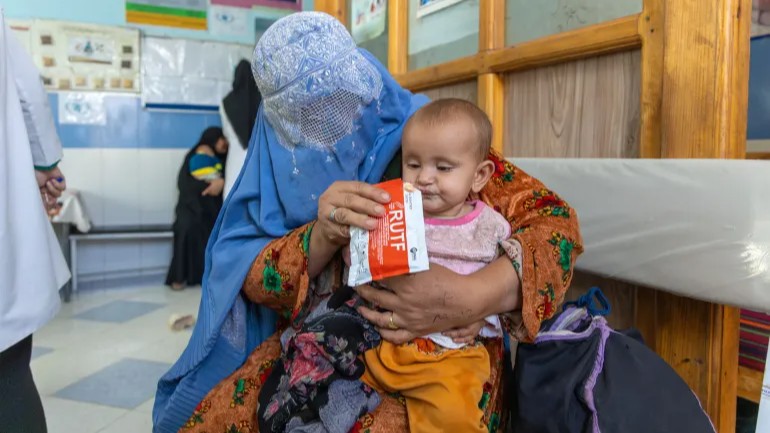
The Kabul Tribune (KT) — An estimated 4.9 million women and children in Afghanistan are expected to need treatment for malnutrition this year as food insecurity, mass returns, disease outbreaks and natural disasters deepen the country’s humanitarian crisis, UNICEF said in a report released Friday.
The U.N. children’s agency said 3.7 million children under
age 5 and 1.2 million pregnant and breastfeeding women are projected to suffer
from acute malnutrition in 2026, with 12 provinces experiencing critical levels
of acute child malnutrition.
In July alone, UNICEF and its partners screened 1.1 million
children for wasting and admitted more than 104,000 for treatment, including
nearly 59,250 children suffering from severe wasting.
The figures come as Afghanistan faces overlapping
humanitarian pressures, with an estimated 21.9 million people — including 11.6
million children — requiring humanitarian assistance this year. About 17.4
million people need urgent food assistance, according to the report.
UNICEF said women and girls remain particularly vulnerable
because of restrictions affecting their access to education, employment, public
life and essential services.
More than 1 million Afghans return
Large-scale returns from neighboring Iran and Pakistan are
adding pressure to already strained communities and public services, UNICEF
said.
About 1.08 million Afghans returned from the two countries
between the beginning of the year and July 31, including more than 652,000 from
Pakistan and about 425,000 from Iran. More than 413,000 of the returns were
deportations, predominantly from Iran.
Since 2023, more than 6.4 million Afghans have returned to
Afghanistan from Iran and Pakistan, according to figures cited by UNICEF.
Women and children account for more than half of the
returnees, many of whom have limited connections to their communities of origin
and face heightened risks of poverty and secondary displacement.
More than 120,000 people returned through major border
crossings in July alone, UNICEF said, with the largest number entering through
Torkham.
Disease outbreaks and floods add pressure
Public health threats also remained high, with 245 disease
outbreaks detected and responded to in July, according to UNICEF.
More than 125,000 cases of epidemic-prone and communicable
diseases were reported during the month, including acute watery diarrhea,
measles, pertussis and Crimean-Congo hemorrhagic fever.
UNICEF said population movements, flooding, limited access
to safe water and fragile health infrastructure were increasing the risk of
disease outbreaks.
Natural disasters have also added to Afghanistan’s
humanitarian needs. Flash floods affected more than 1,100 families across 14
provinces in July, destroying 234 homes and damaging another 930.
Flooding and other natural disasters have affected more than
92,000 people across all 34 provinces since the beginning of 2026, causing 97
reported deaths and damaging or destroying nearly 12,000 homes, UNICEF said.
Floods also damaged or affected 164 schools in eastern and
central Afghanistan, disrupting education for more than 51,000 children,
including over 18,000 girls.
Funding shortfalls
The worsening humanitarian situation is being compounded by
major funding shortages.
The 2026 Afghanistan Humanitarian Needs and Response Plan
requires $1.71 billion, but only $293 million, or 17%, had been received as of
July, according to figures cited by UNICEF.
UNICEF's own $949.1 million humanitarian appeal was 47%
funded as of July 31, leaving a shortfall of about $502.7 million.
UNICEF warned that funding shortages are forcing
humanitarian organizations to prioritize the most urgent life-saving programs
and reduce the scale and geographic reach of some operations.
The agency said recurring natural disasters, mass population
returns, food insecurity, malnutrition, disease outbreaks and economic
pressures continue to compound humanitarian needs across Afghanistan.







