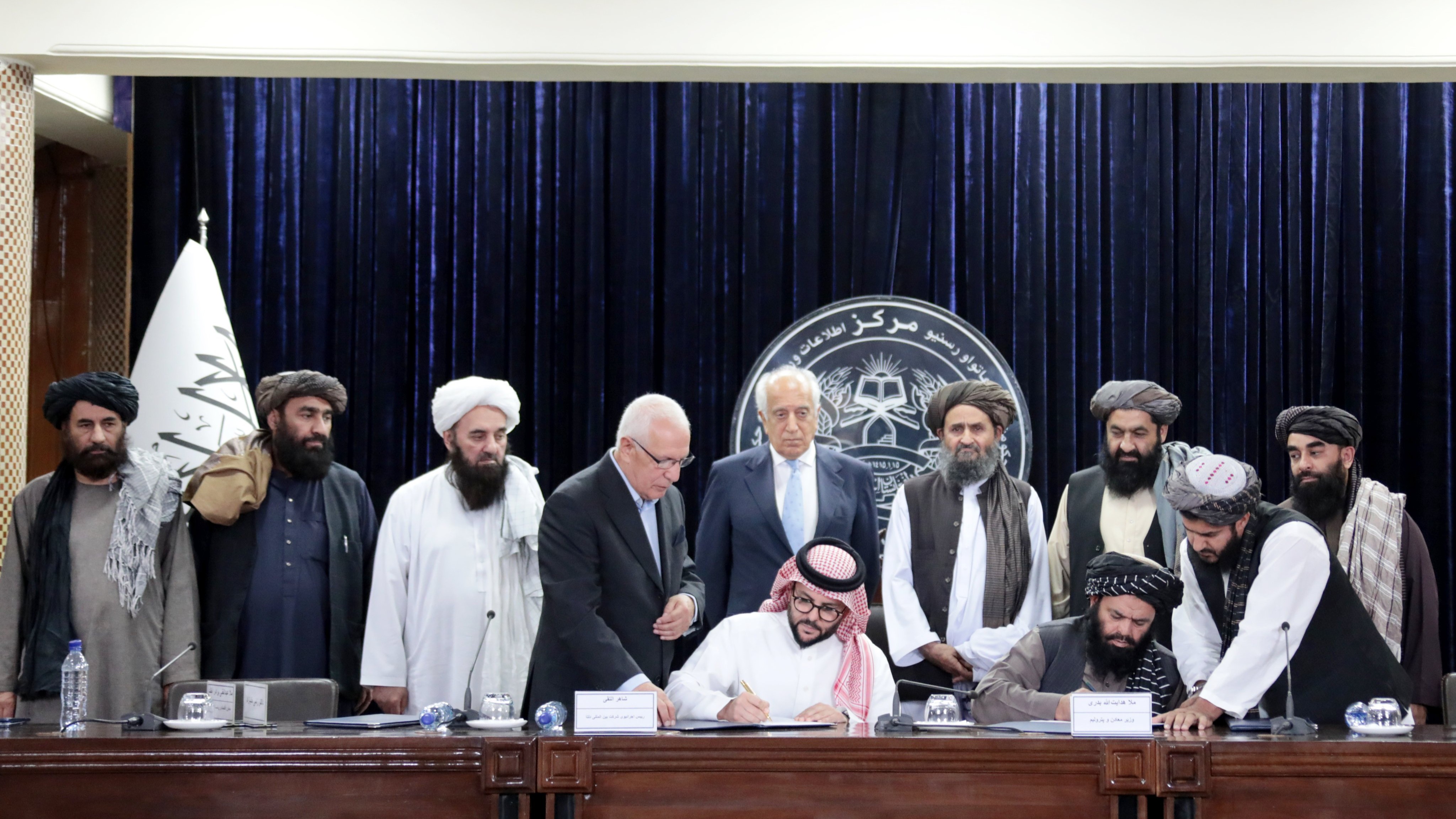
KABUL, Afghanistan — A Saudi Arabian energy group has signed a series of major agreements with Taliban-run Afghanistan’s Ministry of Mines and Petroleum to explore and develop the country’s oil and gas resources, marking a significant new step in the Taliban administration’s efforts to attract foreign investment to its energy sector.
Delta Energy Group said Monday that the agreements cover
hydrocarbon exploration and production in a vast area of western Afghanistan, a
natural gas utilization program in Herat and plans to study a proposed regional
gas transmission pipeline.
The agreements were signed in Kabul in a ceremony attended
by former U.S. special envoy for Afghanistan Zalmay Khalilzad.
The deals cover the Kushk and Tirpul contract area, spanning
about 23,317 square kilometers, where Delta Energy plans to conduct geological
and geophysical studies, seismic work, exploration drilling and reservoir
evaluations to determine the scale and commercial potential of oil and gas
resources.
The company will also finance a study on using natural gas
to support Herat Industrial Park, Herat city and other approved areas,
including for industrial activity and power generation.
A supplementary agreement establishes a framework for
evaluating the proposed 700-kilometer CentGas — Corridor of Prosperity
pipeline, which would run from Guzara district in Herat province to an area
near Spin Boldak in Kandahar province.
The full cost or final value of the agreements remains
unclear. However, the Daily Islambad Post reported that the broader program
could represent up to $60 billion in potential new investment, covering
exploration, field development, gas utilization, pipeline infrastructure and
related facilities.
The proposed investment remains subject to exploration
results, technical and commercial feasibility, financing, regulatory approvals
and final investment decisions.
The proposed CentGas pipeline alone could involve about $10
billion in investment over 10 years, according to Delta, although construction
would depend on the discovery and confirmation of sufficient gas reserves and
the project's economic viability.
The agreements represent one of the most significant recent
energy initiatives announced by the Taliban administration as it seeks to
develop Afghanistan’s largely untapped natural resources and attract foreign
investors.
According to a statement from Abdul Ghani Baradar, the
Taliban administration’s deputy prime minister for economic affairs, Khalilzad
said companies from Saudi Arabia, Qatar, Azerbaijan and Norway have expressed
interest in investing in Afghanistan, particularly in oil and gas exploration
and extraction.







