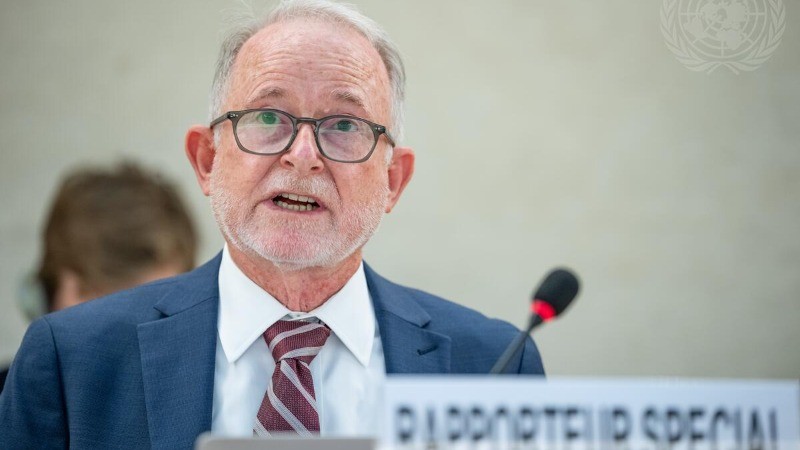
The Kabul Tribune (KT) — A sweeping U.N. report presented Monday accused Afghanistan’s Taliban authorities of deepening a system of institutionalized repression that has weakened protections for women and children, expanded the use of corporal and capital punishment and reshaped nearly every aspect of life in the country.
The report by Richard Bennett, the U.N. special rapporteur
on human rights in Afghanistan, said a series of recent Taliban decrees has
further restricted the rights of women and girls, undermined due process, tightened
controls on religious minorities and free expression and left children exposed
to hunger, exploitation and what Bennett warned could be long-term and
potentially irreversible harm.
Among the most striking developments highlighted in the
report was a new Taliban decree governing criminal court procedures that
Bennett said effectively permits violence against women unless it reaches the
level of “severe beating” resulting in “a fracture, a wound or bruising.”
Even when violence reaches that threshold, the report said,
the burden of proof rests with the woman and the maximum punishment for a
husband is 15 days of detention.
The decree also allows a husband, acting as a private
individual, to impose discretionary punishment on a wife who repeatedly visits her
father or relatives without his permission or what authorities consider a
justification under Islamic law.
The report said the measures were part of an
institutionalized system of gender-based discrimination and persecution that
Bennett has previously said may amount to the crime against humanity of gender
persecution.
Bennett presented the report to the U.N. Human Rights
Council in Geneva as Afghanistan marks just over five years since the Taliban
returned to power in August 2021.
The report describes a country transformed by what it calls
a growing network of restrictive edicts, discriminatory policies and
institutional controls aimed at regulating education, employment, speech,
behavior and personal choices.
“Through both overt repression, enforced with violence, and
more subtle mechanisms of control, such as of education and the media,” the
Taliban authorities are seeking to create a society based on “ideological
conformity, fear and exclusion,” the report said.
New decrees weaken protections for women
Bennett's report focused particular attention on
developments since late 2025, including a decree on the separation of spouses
published in 2026.
While the decree appears on its surface to offer protections
for women, the report said its conditions make it “almost, if not entirely,
impossible” for many women — particularly those in abusive relationships — to
obtain a separation.
Women seeking separation must go through mandatory
arbitration, and separation without a husband's consent may be impossible if authorities
conclude that the alleged abuse or “oppression” can be prevented by other
means, the report said.
Women alleging sexual abuse by their in-laws may be required
to obtain either the husband’s admission of the abuse or witnesses, creating
what Bennett described as almost insurmountable barriers for women experiencing
family or intimate partner violence.
The decree also appears to implicitly validate child
marriage, the report said.
It does not establish a legal age of marriage and includes
provisions concerning marriages involving “boys” and “girls.” A girl who has
reached puberty is considered eligible for marriage, and her silence can be
interpreted as consent, the report said.
That provision contradicts a 2021 Taliban decree that
prohibited child and forced marriage, Bennett said.
The report also cited continuing reports of women and girls
being killed in cases involving domestic violence, child and forced marriage,
inheritance disputes and attacks by unidentified perpetrators.
Bennett said many of the cases were difficult to verify and
that the circumstances of the killings and the status of investigations often
remained unclear, raising concerns about impunity and the safety of women and
girls.
Arrests and violence over dress-code restrictions
The report said Taliban authorities continue to enforce
restrictions on women through detention and other punitive measures.
In January, a young woman taekwondo coach was detained for
nearly two weeks, allegedly for running a gym for girls in the western city of
Herat.
On June 6 and 7, Taliban officials and police reportedly
detained at least 30 women and girls — and possibly more — over alleged
violations of dress-code rules in Herat.
Protests followed the arrests. On June 9, Taliban police
allegedly fired toward demonstrators, killing at least two people, including a
boy, and injuring at least 20 others, according to the report.
The report said that while girls and young women bear the
brunt of Taliban policies, boys and men also face increasing restrictions on
their autonomy and self-expression.
Young men told the special rapporteur that they no longer
felt free to choose their clothing or appearance or socialize with friends
without fear of interference or harassment.
Death penalty and corporal punishment
The report said the Taliban's new decree on criminal court
rules also raises major concerns over due process and the rule of law.
According to Bennett, the decree does not clearly enumerate
the rights of accused people or procedural guarantees to protect them. Some
offenses punishable under the Taliban’s discretionary justice system can be
established despite doubt, contrary to the presumption of innocence, the report
said.
The decree also allows private individuals to impose
discretionary punishment on grounds of “public interest,” without defining what
that term means.
Bennett said the decree codified the death penalty as a
discretionary punishment for offenses including blasphemy and certain sexual
acts and in cases where authorities decide an execution would serve “public
interest” or “public expediency.”
The breadth of the provisions raises serious concerns under
international law, which restricts capital punishment to the “most serious
crimes,” the report said.
The decree also codified lashing as punishment for a range
of offenses, including insulting religious figures or Taliban leaders and
eating or drinking during the daytime fasting period of Ramadan.
The Taliban Supreme Court stopped publishing records of
court-ordered corporal punishment in April, but the report said there was no
indication that the practice had ended or declined.
People perceived as LGBTQ+ remain particularly vulnerable,
the report said. The new criminal rules provide imprisonment for “sodomy” and
allow the death penalty for repeated offenses.
Bennett said the decree does not distinguish between
consensual and nonconsensual sexual acts, meaning survivors of sexual violence
could potentially face punishment alongside perpetrators.
Religious minorities and a deadly attack in Herat
The report said the Taliban has continued to restrict
religious minorities, particularly Shiite Muslims.
A decree on preachers issued in December 2025 allows only
Muslims following the Hanafi school of Islam to be officially recognized as
preachers and requires preaching to follow that school, the report said.
The decree on separation of spouses also discriminates
against Shiite Muslims by preventing them from having their marital status
determined under their own religious jurisprudence, Bennett said.
The report also highlighted continuing violence against
minorities.
On April 11, four unidentified individuals allegedly opened
fire on people gathered near a Shiite shrine in Injil district of Herat after
separating men from women and searching the men, the report said.
Witnesses told the special rapporteur that 13 ethnic Tajik
Shiite Muslims were killed.
Bennett called for a thorough, impartial and effective
investigation.
Tightening restrictions on media and speech
The report said Taliban authorities have also tightened
their control over expression and peaceful assembly.
The criminal court decree criminalizes a broad range of
criticism or conduct deemed insulting toward religious figures, scholars, imams
and public officials, the report said.
The Taliban has also expanded restrictions on
communications. After fiber-optic internet services were shut down in several
provinces in September 2025, all internet and telecommunications services were
suspended nationwide between Sept. 29 and Oct. 1, the report said.
The shutdown had particularly serious consequences for women
and girls, for whom internet access provided a vital connection to education,
information and the outside world.
In June, Taliban authorities reportedly prohibited
government employees from using smartphones. Provincial officials in some areas
were reported to have collected and destroyed phones, while university
employees and journalists also faced restrictions affecting their ability to
obtain information.
The arbitrary detention of journalists has continued, the
report said.
The Afghanistan Journalists Centre documented the detention
of at least 34 journalists by Taliban authorities in 2025. At least three more
journalists were reportedly detained in May, including two journalists from the
broadcaster TOLOnews following an intelligence raid on its office.
A woman journalist was reportedly detained in Kabul in June
for working with a male camera operator who was not her relative. Taliban
authorities also reportedly detained the managing editor and another employee
of Tamadon TV, one of the few remaining independent television stations.
Killings of former officials
Bennett also reiterated concerns over the killings of former
Afghan government officials and members of the former security forces despite a
Taliban-declared general amnesty.
The U.N. mission in Afghanistan reported that at least 27
former security personnel were killed between October 2025 and June 2026, although
other human rights sources indicated that the actual number could be
significantly higher, the report said.
Former security personnel have also reportedly been
subjected to prolonged detention without due process, torture and other
mistreatment.
Children at the center of the crisis
Although the report covered the broader human rights
situation, Bennett placed particular emphasis on children and young people, who
make up roughly half of Afghanistan's population.
The Taliban has dismantled Afghanistan's previous child
protection framework, suspended key laws and closed or disrupted institutions
that provided protection and specialized services for vulnerable children, the
report said.
Most fundamentally, Afghanistan no longer has a legal
definition of a child because the 2019 Law on the Protection of Child Rights,
which defined a child as anyone under 18, has been suspended, according to
Bennett.
Other laws protecting children and providing for juvenile
justice and rehabilitation have also been suspended.
Child protection centers providing shelter and specialized
support have closed. Some girls, including survivors of sexual abuse and family
separation, were reportedly transferred to state-run orphanages, while some
boys were sent to religious schools.
Many experienced child protection workers have reportedly
been replaced by Taliban members without specialized expertise, raising
concerns about the ability of the system to protect vulnerable children.
The dismantling of the juvenile justice system has also left
children without many of the procedural safeguards and rehabilitation services
that previously existed, the report said.
The new criminal decree appears to permit corporal
punishment of children and imposes sanctions on teachers or instructors only
when beatings cause broken bones, skin injuries or visible bruising.
Millions of girls excluded from education
The Taliban’s continuing ban on girls attending school
beyond the sixth grade and women attending universities remains one of the
central findings of the report.
Bennett said the restrictions form part of an
institutionalized system of gender-based discrimination and persecution that
may amount to a crime against humanity.
In 2024, an estimated 3.8 million Afghan girls between the
ages of 7 and 18 were out of school, including more than 2.6 million adolescent
girls, according to UNICEF figures cited in the report.
Over the past five years, restrictions on secondary
education have directly affected at least 1 million girls, and that number
could exceed 2 million by 2030 if current policies remain unchanged.
Girls who remain in primary school also face restrictions.
The report said Taliban inspectors have monitored some
schools and, in Herat, have reportedly measured girls' height and prevented
some who were considered to have reached puberty from continuing their
education or required them to wear a full hijab.
Despite the restrictions, girls and women have continued to
seek education through online classes, clandestine schools and other informal
learning networks.
More than 100 organizations are now providing online,
community-based and cross-border education opportunities, the report said,
although access remains limited, especially for rural and poor families without
reliable internet or digital devices.
The report also warned that the rapid expansion of religious
schools could reshape Afghanistan’s education system and social fabric.
The number of registered, repurposed or newly established
religious institutions increased from about 5,000 before the Taliban takeover
to more than 23,000 by September 2025, the report said.
At the same time, boys have reportedly experienced declining
educational quality because of shortages of qualified teachers and the removal
or restriction of subjects including art, sports, English and civic education.
Economic hardship is also forcing many boys to leave school and work.
Hunger, malnutrition and mental health crisis
Afghanistan's wider humanitarian crisis has compounded the
effects of Taliban policies, particularly for children.
About 9 million children — roughly one in three — are facing
severe hunger, while 3.7 million children under age 5 are acutely malnourished,
according to figures cited in the report.
Children have reportedly gone to school hungry and struggled
to concentrate because of inadequate food.
Bennett also said he was gravely concerned about high levels
of psychological distress among children and young people, particularly girls.
The denial of education, restrictions on freedoms, lack of
future opportunities and chronic poverty are worsening existing mental health
problems, the report said.
Some girls have reportedly attempted suicide, although such
cases may be underreported because of stigma and social and religious
sensitivities.
Unless restrictions are lifted and child-sensitive mental
health services are strengthened, the report warned that an entire generation
of Afghan girls and boys could suffer long-term and potentially irreversible
harm to their well-being and development.
Child labor, forced marriage and sexual violence
The report said child labor, particularly among boys, is
increasing as poverty and food insecurity force families to rely on their
children's income.
Children are reportedly working in agriculture, brickmaking,
mining and domestic labor, while the work performed by girls may be
underreported because much of it takes place inside homes.
Child and forced marriage are also reportedly increasing
despite a Taliban decree prohibiting the practice.
The report cited accounts of girls being married to
significantly older men, entering polygamous marriages and being sold to settle
family debts. Some girls were reportedly forced to marry people affiliated with
the Taliban or faced detention and retaliation for resisting such marriages.
Children also continue to face rape, sexual violence and the
practice known as bacha bazi, involving the sexual exploitation of boys, the
report said.
Although Taliban law prohibits conduct associated with bacha
bazi, the practice reportedly continues, including allegedly among Taliban
officials and local commanders.
Some boy victims have allegedly been imprisoned for
“sodomy,” the report said.
Children in schools and religious schools are also
reportedly subjected to beatings, humiliation and verbal abuse by teachers and
religious instructors.
Children are being arrested and detained, sometimes
alongside adults, and boys have reportedly been flogged alongside adults for
offenses including theft, drug-related allegations and accusations involving
extramarital relationships.
Children killed, recruited and injured by explosives
Children continue to suffer from violence despite the end of
the large-scale war that preceded the Taliban's return to power.
The report cited 1,070 grave violations against children in
Afghanistan during 2025.
It said 103 children were killed or injured in cross-border
shelling and airstrikes by Pakistani forces during that year.
Between January and June 2026, 72 children were killed and
183 injured, according to the U.N. mission in Afghanistan.
The report also cited continued recruitment of children by
Taliban forces.
In 2025, Taliban authorities recruited 204 boys, including
62 for combat roles and 142 for support roles, according to a U.N. report cited
by Bennett.
He said the absence of a legal definition of a child could
facilitate the recruitment and use of children.
Explosive remnants of decades of conflict remain another
major danger.
About 130 children were killed or injured by unexploded
ordnance between January and May 2026, the report said, while another estimate
cited by Bennett found that nearly one Afghan child is killed or injured by
explosive ordnance every day on average.
Returnee children and children with disabilities
The report highlighted the particular vulnerability of
children returning to Afghanistan amid mass deportations from neighboring
countries.
A significant proportion of the nearly 2.9 million Afghans
who returned from neighboring countries in 2025 were children and young people,
with about 42% under 15 and nearly two-thirds under 25.
More than 8,000 unaccompanied or separated children were
documented among returnees from Iran and Pakistan in 2025, the report said.
Some were separated from their families during deportation
procedures or because parents or caregivers were detained or unable to travel.
These children face heightened risks of exploitation,
violence and trafficking, particularly when they have no family members or
meaningful social connections in Afghanistan.
Children with disabilities face additional barriers because
of deteriorating public services, the closure or inadequate support of
specialized education centers and a shortage of accessible health and
rehabilitation services.
Girls with disabilities have faced particularly severe
restrictions on access to education, the report said.
Call for accountability
In his conclusions, Bennett said the Taliban has
consolidated a governance system intended to reshape Afghan society according
to its ideological vision.
The consequences go beyond individual human rights
violations, he said, fundamentally changing the conditions in which Afghan children
and young people grow, learn and develop.
Without a change in direction, the report said, the
cumulative impact of Taliban policies will continue to shape future generations
and limit their ability to exercise their rights and contribute to Afghanistan's
future.
Bennett called on Taliban authorities to dismantle the
institutionalized system of gender discrimination, revoke restrictions on women
and girls, replace the decree on separation of spouses, restore protection
mechanisms and revoke the 2026 criminal court decree.
He also called for the adoption of an internationally
recognized legal definition of a child, the restoration of child protection
mechanisms, a prohibition on corporal punishment and stronger enforcement
against child and forced marriage.
The report urged governments not to normalize relations with
or legitimize the Taliban until there are significant, measurable and
independently verified improvements in human rights, particularly for women and
girls.
It also called for increased humanitarian funding, greater
protection for vulnerable Afghans, an end to involuntary deportations, support
for Afghan refugees and accountability for human rights violations.
The report was based on consultations with 102 Afghan
participants from 24 provinces, including human rights defenders, teachers,
health workers, parents and young people, as well as submissions from
organizations and meetings with U.N. agencies, Afghan and international
experts.
Five years after the Taliban returned to power, Bennett's
report concluded that Afghanistan's human rights crisis is no longer limited to
individual restrictions or isolated abuses, but has become an increasingly
entrenched system whose effects could be felt for generations.







