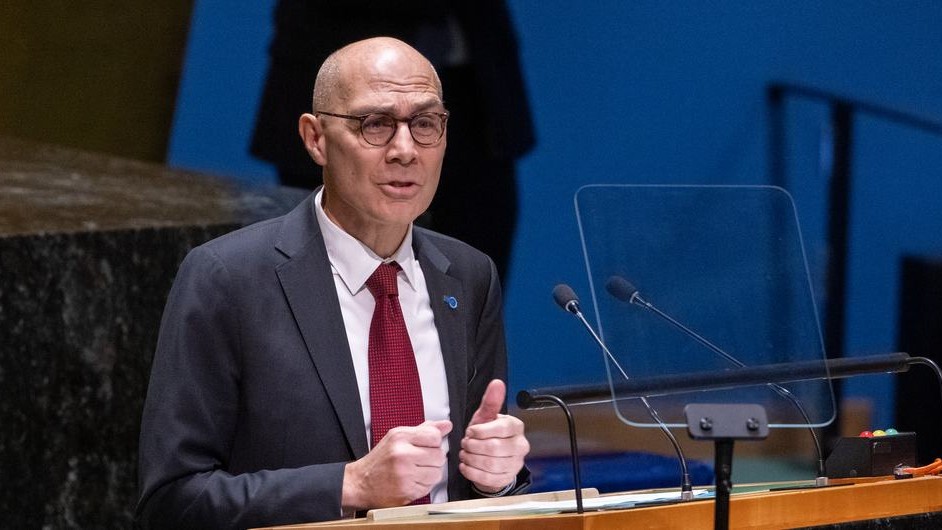
The Kabul Tribune (KT) — U.N. High Commissioner for Human Rights Volker Türk condemned what he described as increasingly oppressive restrictions imposed by Afghanistan’s de facto authorities, particularly against women and girls, and called for renewed international pressure on the Taliban to meet the country’s obligations under international law.
Türk said the human rights situation in Afghanistan is
deteriorating as millions face poverty, hundreds of thousands of Afghans are
forcibly returned to the country and restrictions on basic freedoms continue to
tighten.
“Today, the plight of many in Afghanistan is going from bad
to worse,” Türk said. “The silence is deafening.”
He criticized restrictions affecting women and girls’ access
to education, employment, freedom of movement and public life, as well as
strict requirements on dress and the exclusion of women from public
decision-making.
New decrees issued this year have made it more difficult for
women to separate from their spouses and have implicitly authorized child
marriage and violence against women and children, Türk said.
Since the Taliban returned to power in 2021, about 2.2
million Afghan girls and women have been denied access to secondary and higher
education, according to the U.N.
“This systematic exclusion of women and girls from public
life is an unacceptable human rights violation that has become normalized and
institutionalised by the de facto authorities,” Türk said, describing the
restrictions as amounting to “gender apartheid.”
The de facto authorities have also arrested Afghan women and
men over alleged violations of rules concerning dress, beard length and music,
according to Türk. At least 449 men and women were subjected to corporal
punishment during the first half of the year, he said.
Human rights violations against former government officials
and former members of the Afghan National Defense and Security Forces also
continue to be documented, Türk said.
He said religious minorities, including Shi’a and Ismaili
communities, continue to face restrictions, while Afghan media outlets operate
under censorship and other limitations.
Journalists continue to face arrest, and some media outlets
have been temporarily closed, Türk said. Media organizations are prohibited
from broadcasting or publishing material that the de facto authorities consider
contrary to Afghan culture or their regulations.
The U.N. human rights chief also expressed concern over the
forced return of Afghans from neighboring countries.
According to the U.N. refugee agency, more than 400,000
Afghans have been forcibly returned, mainly from Iran and Pakistan, with
smaller numbers returned from Türkiye and Tajikistan. Türk also noted that several
European Union member states have increased coordination with the de facto
authorities over the return of Afghan nationals.
“Many are forced to enter a country where they have never
even stepped foot,” Türk said, warning that returnees face poverty and
inadequate access to food, clean water, health care, education and employment.
An estimated 21.9 million people, or about 45% of
Afghanistan’s population, require humanitarian assistance, he said.
Türk also warned that declining foreign aid is worsening the
humanitarian crisis and urged governments to put the needs of Afghanistan’s
population first.
“At the same time, those with influence in the region must
stand up, and speak out for the equality and dignity of all Afghans,” Türk
said. “No matter where we make our homes, these principles are inviolable.”







