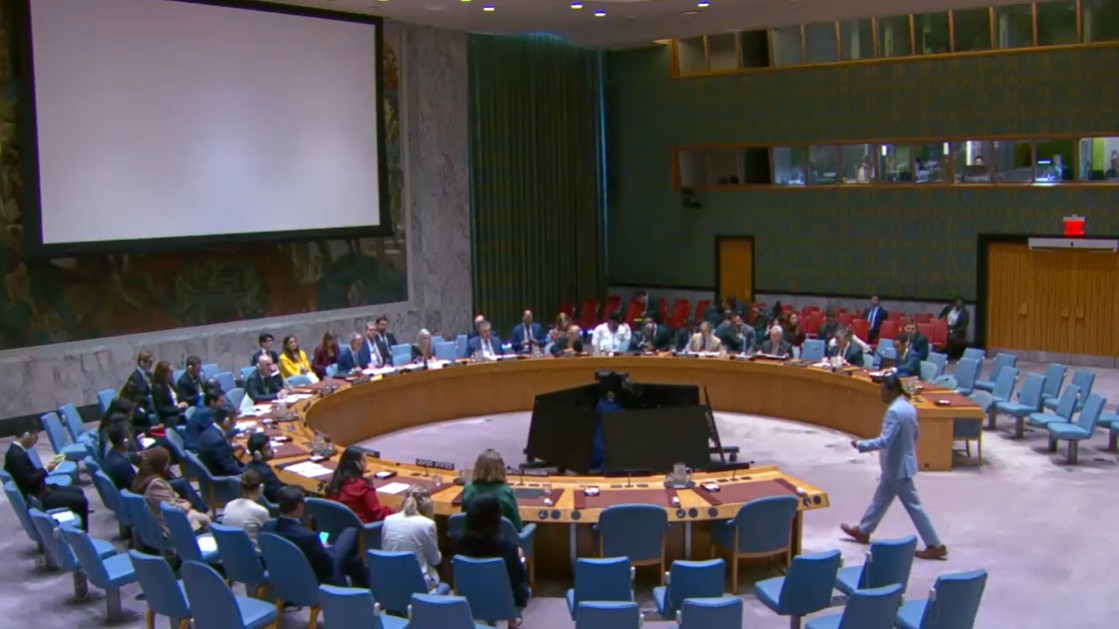
The Kabul Tribune (KT)— The U.N. Security Council on Wednesday discussed Afghanistan’s security, political, humanitarian and human rights situation, with speakers raising concerns over restrictions on women and girls, terrorism, governance, humanitarian needs, mass returns and regional security.
UNAMA said Taliban authorities have highlighted security and
economic gains after five years in power, but Afghanistan continues to face
severe restrictions on women and girls, human rights abuses, exclusionary
governance and terrorist threats.
Council members broadly agreed that restrictions on women
and girls remain a major obstacle to Afghanistan’s recovery and international
reintegration. Speakers also warned about worsening humanitarian needs, refugee
returns, media restrictions, economic fragility and growing regional security
concerns.
Afghanistan’s delegate said five years was “long enough to
judge the situation by actions.”
He said Afghanistan still lacks an inclusive political
system, an accepted constitutional framework and accountable institutions
through which Afghans can influence decisions affecting their lives.
“The absence of large-scale war should not be mistaken for
sustainable peace,” he said.
He described the repression of women and girls as “not only
a women’s rights crisis” but also a national crisis affecting Afghanistan’s
economy, health, education, development and long-term stability.
The Afghan representative said the international community
should move beyond what he described as a false choice between isolation and
normalization, and pursue principled and outcome-oriented engagement aimed at
legitimate and accountable governance. He also said UNAMA should work to create
conditions for a political solution.
Pakistan’s envoy, Iftikhar Ahmad, raised concerns about
terrorist threats from Afghanistan and their implications for Pakistan’s
security.
“Terrorism has been at the core of Afghanistan’s problems.
This finds its roots in the deep nexus between the Taliban and terrorist
groups, such as the TTP, BLA and Majeeb Brigade,” Ahmad said.
The U.S. representative said Washington would not tolerate
the Taliban using American citizens as “bargaining chips.”
Criticizing the Taliban’s record, he said: “I’ve seen them
hang children, terrorize families, pillage whole villages and prey on the very
people they claim to represent.”
He also criticized restrictions on women and girls, saying Afghanistan
remains the only country where girls and women are barred from higher
education. After 20 years of progress, he said, “that door is now closed on
them.”
The U.S. representative called for greater accountability,
saying, “This Council must demand results from the Taliban regime.”
Kate Foster, the U.K. deputy permanent representative to the
U.N., welcomed the appointment of Rabab Fatima as the U.N. secretary-general’s
special representative for Afghanistan and reaffirmed Britain’s commitment to
UNAMA.
Foster said the U.K. strongly condemns the Taliban’s
systematic discrimination against women and girls.
“No country can prosper while half its population is
excluded from public life,” she said, calling on the Taliban to respect the
fundamental rights and freedoms of all Afghans in accordance with international
law.
Foster also noted that one year had passed since Taliban
authorities barred Afghan women working for the United Nations from accessing
U.N. premises. She called on the Taliban to lift the restriction, saying it
continues to hamper the delivery of essential assistance to Afghans.
China’s envoy called on the Taliban to safeguard the rights
of all people in Afghanistan, including women and girls, and urged the
authorities to lift restrictions on women and girls.
Russia’s envoy raised concerns over the continued presence
of terrorist groups in Afghanistan, specifically naming Daesh-Khorasan, or
ISIS-K, and the East Turkistan Islamic Movement, or ETIM.
Speakers urged the Taliban to restore women’s rights, allow
female U.N. staff to work, establish inclusive governance structures and meet
their counterterrorism commitments.
They also encouraged donors to sustain humanitarian funding
and called on the U.N. and Security Council to maintain principled engagement,
accountability efforts and support for political dialogue.







