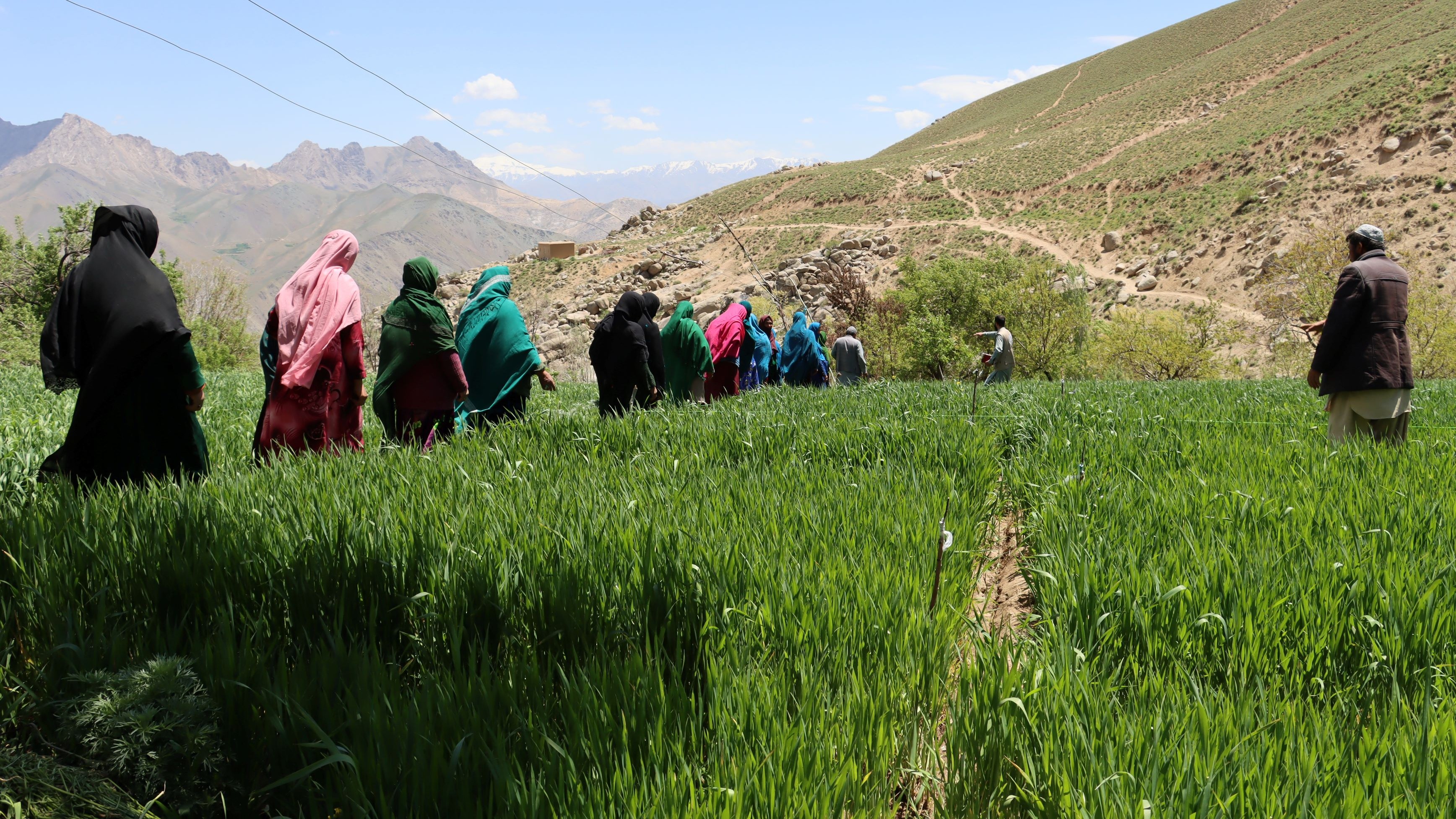
The Kabul Tribune (KT) — Wheat farmers in Afghanistan’s central highlands are testing planting methods that use less seed and shallower sowing depths, practices that the U.N. Food and Agriculture Organization says could help increase yields while reducing waste and production costs.
In Daikundi province, many farmers have traditionally
scattered between 70 and 100 kilograms of wheat seed over each jerib of land,
believing that more seed will produce a larger harvest, according to an FAO
report. Farmers have also tended to bury seeds 15 to 20 centimeters deep to
protect them from the winter cold.
FAO said those practices can reduce crop performance.
Overcrowded plants compete for sunlight, water and nutrients, while seeds
planted too deeply may emerge slowly or fail to reach the surface.
During the 2025-26 growing season, FAO established wheat
demonstration plots in several parts of Afghanistan, including Daikundi,
allowing farmers to compare traditional and improved planting methods under
local conditions.
The plots compared three approaches: broadcasting large
quantities of seed, broadcasting 35 kilograms of seed per jerib at a depth of 3
to 5 centimeters, and planting about 25 kilograms per jerib in rows at the same
shallow depth.
Farmers took part in assessing the plots by examining the
plants, counting tillers — shoots that grow from the base of a wheat plant —
and comparing the strength of the plants and their wheat spikes.
“Before, we thought that using more seed would give us more
yield, but now we know that is not true,” Zakaria, one of the participating
farmers, said, according to FAO. “More seed does not always bring better
results.”
Another farmer, Mahmood, said wheat planted using the
traditional high seed rate produced weaker plants with about three tillers,
while plants grown in rows with less seed produced as many as 15 tillers.
Haji Qamber, another participating farmer, counted as many
as 90 grains on individual wheat spikes in the row-planted plots, according to
FAO.
FAO said broadcasting can distribute seed unevenly, leaving
some parts of a field overcrowded while others remain sparsely planted. Dense
planting can also trap moisture and create conditions favorable to wheat rust
and other diseases.
Planting fewer seeds evenly in rows gives plants more room
to develop roots and produce tillers, the agency said. Rows can also make
weeding and other fieldwork easier and improve airflow between plants.
The demonstrations also showed benefits from planting seeds
closer to the surface. FAO said wheat emerged more quickly and evenly in plots
where seeds were planted at shallow depths, while many seedlings failed to
reach the surface in fields where seeds had been buried 10 to 20 centimeters
deep.
Using less seed could help farmers reduce waste and
production costs while making more efficient use of limited land, water and
fertilizer, according to FAO. The agency said the issue is particularly
important in Daikundi, where arable land is limited and farmers face rising
input costs.
The demonstrations are part of FAO’s broader support for
wheat cultivation in Afghanistan. With funding from the Asian Development Bank,
the European Union and the governments of Japan and the United Kingdom, as well
as the World Bank, FAO distributed 168,208 wheat cultivation packages during
the 2025-26 growing season.
Each package included certified wheat seed, fertilizer and
practical training.
An FAO assessment found that farmers who received the
packages recorded yields 32.8% higher than those who did not receive them. For
a household cultivating two jeribs, the increase amounted to an additional 0.36
metric tons of wheat, enough, according to FAO, to meet the annual wheat needs
of two additional family members.
The assessment also found that straw yields increased by
6.3%, which FAO said was important for households that use wheat straw as
livestock feed.
The demonstration plots are intended to build on that
support by helping farmers use seed and other agricultural inputs more
efficiently.
FAO said it plans to expand the demonstration approach so
more farmers can test the methods under their own local conditions before
deciding whether to adopt them.
With seed and fertilizer costs rising, the agency said,
using the appropriate amount of seed and planting it at the right depth could
help Afghan farmers reduce waste and improve the prospects for the next wheat
harvest.







