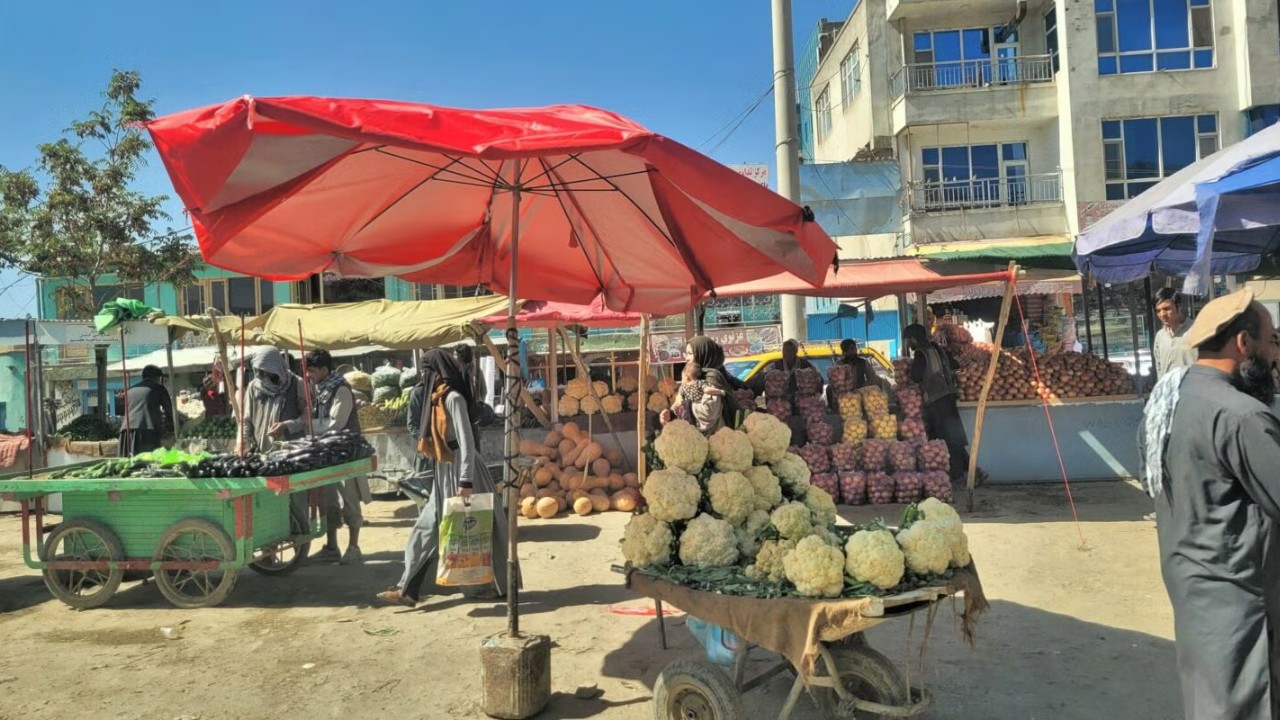
The Kabul Tribune (KT) — Prices of several essential food commodities in Afghanistan remained significantly higher than a year ago during the first week of October, while limited job opportunities and declining purchasing power continued to strain households’ ability to afford food, according to the United Nations World Food Programme (WFP).
In its weekly market assessment, WFP reported generally
modest week-on-week price movements but persistent annual increases in rice,
wheat, cooking oil, sugar and salt. High fuel and fertilizer costs also
continued to add pressure to transportation, agricultural production and supply
chains.
Wheat grain prices rose 0.6% during the week, while
high-price wheat flour remained unchanged and low-price wheat flour declined
0.2%. Compared with the same period last year, wheat grain and low-price wheat
flour were each 10% more expensive, while high-price wheat flour increased 6%.
Rice prices declined during the week, with Palawi falling
1.9% and Sholae dropping 1.7%. However, Palawi remained 17% above its
year-earlier price, while Sholae was 31% higher. Both varieties also remained
well above their three-year averages, by 19% and 20%, respectively.
Prices of other staple foods showed limited weekly changes.
Cooking oil was 12% more expensive than a year earlier, while sugar rose 10%
and salt increased 4%. Pulses and bread, by contrast, were 12% and 3% cheaper
than their respective year-earlier levels.
Vegetable prices generally declined during the week.
Potatoes fell 4.1%, onions dropped 3.1% and tomatoes edged down 0.2%.
Despite the weekly decreases, potato prices remained 25%
higher than a year earlier and 23% above their three-year average. Tomato prices
were 55% lower than their year-earlier level, while onion prices declined 6%.
Limited employment weakens household purchasing power
WFP’s assessment also highlighted continuing pressure on
households dependent on casual labor, as fewer work opportunities and lower
wages reduced their ability to buy food.
The purchasing power of an unskilled laborer’s daily wage
was equivalent to 9.9 kilograms of low-price wheat flour, a measure known as
the terms of trade. That was 13% below the year-earlier level and 12% below the
three-year average.
Unskilled workers were finding employment for an average of
two days per week, 14% below the level recorded a year earlier and 21% below
the three-year average. Their wages also declined 5% year-on-year.
After accounting for food prices, the real purchasing power
of unskilled laborers was 25% lower than a year earlier and 30% below the
three-year average, according to the assessment.
Livestock-dependent households also faced weaker purchasing
power. A pastoralist could exchange a one-year-old female sheep for 260
kilograms of low-price wheat flour, 12% less than a year earlier and 7% below
the three-year average.
Fertilizer prices remain above year-earlier levels
Agricultural input prices showed mixed weekly movements but remained
elevated compared with last year.
Diammonium phosphate, or DAP, fertilizer prices increased
0.3% during the week, while urea prices declined 1.8%. Despite those changes,
DAP remained 10% more expensive than a year earlier, while urea prices were 24%
higher.
Improved seed prices were 8% lower than a year earlier, and
animal feed prices declined 5%.
The figures point to continuing financial pressure on Afghan
households, particularly those relying on daily wages or livestock income.
Although several food prices declined slightly during the week, the combination
of elevated staple prices, limited employment and weaker purchasing power
continues to constrain access to food.
WFP’s weekly market monitoring tracks changes in food prices
and other economic indicators to assess how market conditions affect
households’ ability to meet their basic food needs.







