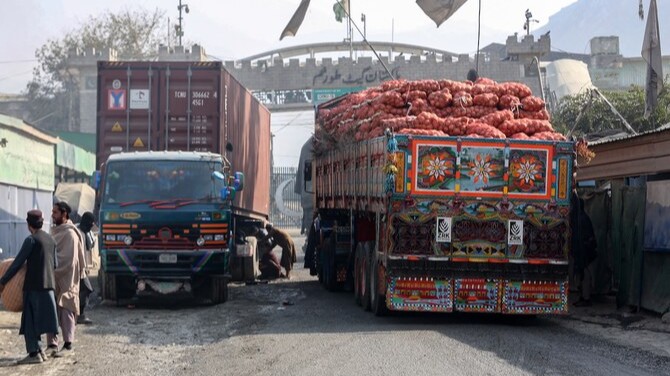
The Kabul Tribune (KT) — The Taliban say they are offsetting losses from the closure of key border crossings with Pakistan by redirecting trade through Iran and Central Asian countries, as official figures show a sharp increase in regional commerce.
Taliban spokesman Zabihullah Mujahid told Afghanistan’s
state-run National Television on Tuesday that the country’s import and export
needs were being met through alternative routes.
The main crossings between Afghanistan and Pakistan,
including Torkham and Spin Boldak, were closed after border clashes between the
two sides in October 2025. The closures forced Afghan traders to reroute
shipments, disrupting a trade relationship that was valued at about $2.35
billion annually before the crossings shut.
However, the increase in trade with Central Asia does not mean
that all losses from the disruption have been fully recovered.
According to the World Bank, 48% of Afghanistan’s imports
came through Central Asia in August, while 46% entered through Iran. Pakistan’s
share fell to nearly zero.
Trade between Afghanistan and five Central Asian countries —
Uzbekistan, Turkmenistan, Tajikistan, Kazakhstan and Kyrgyzstan — reached $2.62
billion in 2025, an increase of 45% from the previous year, according to
figures from the Taliban-run Ministry of Industry and Commerce.
Imports from those countries rose 43%, while Afghanistan’s
exports to them increased 77%. Some of that growth, however, occurred before
the Pakistani border crossings closed.
Trade between Afghanistan and Central Asia totaled $1.278
billion in the first five months of 2026, according to the ministry. Imports
accounted for $1.204 billion, while exports totaled $74 million.
Meanwhile, the value of Afghan exports to other countries
through Pakistan’s Wagah crossing and seaports dropped from $454 million in
fiscal year 2025 to $7 million in fiscal year 2026, the figures showed.
Before the closures, direct trade between Afghanistan and
Pakistan was estimated at at least $6.45 million a day, or about $2.35 billion
a year.
The World Bank has reported that the border closures reduced
Afghanistan’s food exports and nearly halted coal exports. Textile exports, by
contrast, increased, with some shipments reaching China through Central Asian
routes.







